
As the demand for energy efficiency and reducing environmental impacts grows, the importance of employing advanced technologies in heating systems has become more important than ever. One of these advanced technologies is condensing boilers, which, by using energy optimization principles, provide much higher efficiency than conventional boilers. These boilers reduce fuel consumption by using the latent heat of water vapor in combustion gases, while providing greater efficiency. For an initial introduction to industrial boilers, it is recommended to review the article “Overview of Industrial Boilers “.
Condensing boilers, due to their unique design and high efficiency, are an ideal choice for a variety of heating systems, including residential heating, pools, and different industries. This article discusses the features, advantages, types, and uses of these boilers to illustrate how this technology can contribute to energy optimization and cost reduction.
What is a Condensing Boiler?
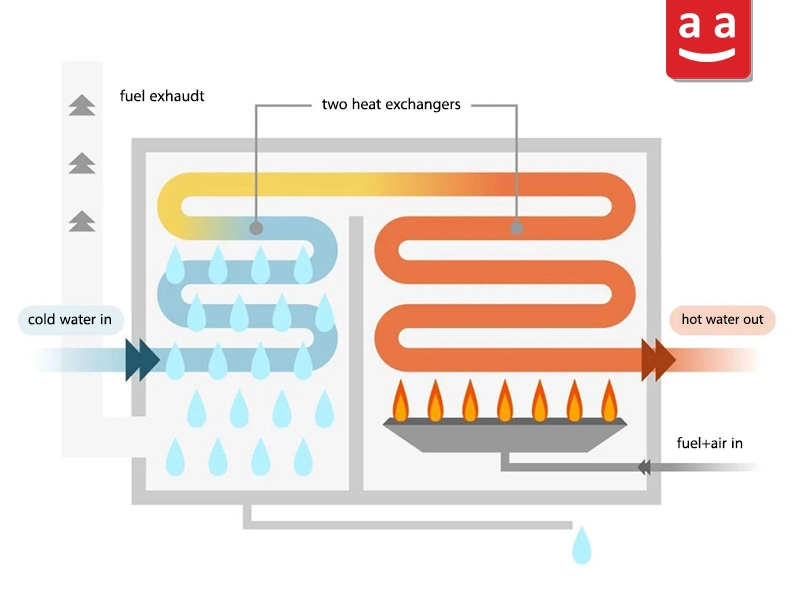
A condensing boiler is a type of advanced boiler that delivers higher efficiency than conventional boilers by using latent heat recovery technology to capture the heat contained in the water vapor present in combustion products. In these boilers, water vapor is condensed through two different mechanisms. Condensing boiler can be designed as either hot water boiler or steam boiler.
If the boiler is designed so that the temperature of the flue gases produced by combustion falls below the dew point temperature, the water vapor contained in these gases condenses and turns into liquid. Likewise, if the temperature of the water entering the boiler is lower than the dew point temperature of the combustion products, the water vapor in the combustion gases condenses. During this process, the latent heat contained in the water vapor is released and transferred to the water inside the boiler. This is why these boilers are referred to as condensing boilers.
By recovering this latent heat, the boiler can produce more useful heat while consuming less fuel, thereby increasing its overall efficiency. The efficiency of condensing boilers can reach approximately 98%. Because the condensed water vapor is acidic and comes into direct contact with the boiler tubes and flue system, corrosion-resistant materials such as 316 stainless steel must be used.
Advantages of Condensing Boilers
Condensing boiler, due to its advanced design and use of energy optimization technology, offers several advantages, including:
Higher Thermal Efficiency: These boilers are more efficient than non-condensing ones due to the use of the latent heat of water vapor in exhaust gases.
Lower Fuel Consumption: This type of boiler leads to better energy utilization, resulting in reduced fuel consumption and lower energy costs.
Compact Design: Condensing boiler is typically compact and small, requiring less space in boiler rooms. They are particularly practical for limited spaces.
Lower Carbon Dioxide Emissions: The reduction in fuel consumption and enhanced energy efficiency result in lower carbon dioxide emissions. This characteristic helps reduce harmful environmental impacts and mitigates climate changes.
Considering the mentioned advantages of condensing boilers, the “Planta” system, designed and manufactured by Packman, utilizes this type of boiler. This system is one of the CO₂ injection systems and plays an important role in optimizing plant growth conditions. For a deeper understanding of this system as well as the heating systems used in greenhouses, you can refer to the article Greenhouse Heating Systems.
Types of Condensing Boilers
Condensing boilers are available in a variety of structural designs, each offering distinct technical advantages and performance characteristics. Broadly, these boilers are manufactured in two primary configurations: fire-tube and water-tube. Selecting the most suitable design depends on several factors, including the required heating capacity, available boiler room space, and the type of fuel being used. The table below outlines the key features, benefits, and typical applications of the main types of condensing boilers.
|
Type |
Description |
Applications |
|
Coil-Type Condensing Boiler (Water-Tube) |
Water flows through tubes or coils and is heated by absorbing energy from the burner flame. The boiler features separate combustion and condensation chambers. |
High-capacity systems, industrial applications, and facilities that require operation with virtually any water quality, including untreated water without a water softener. |
|
Compact Condensing Boiler (Condensing Heat Exchanger Type) |
An advanced generation of water-tube boilers with a compact footprint. A premix burner is mounted at the top, while water circulates through specially designed channels. |
Buildings with limited mechanical room or boiler room space. |
|
Condensing Fire-Tube Boiler |
Hot combustion gases pass through stainless-steel fire tubes, transferring heat to the water surrounding the tubes. |
Systems requiring the use of gas-fired or dual-fuel burners (natural gas and oil). |
Coil-Type Condensing Boiler
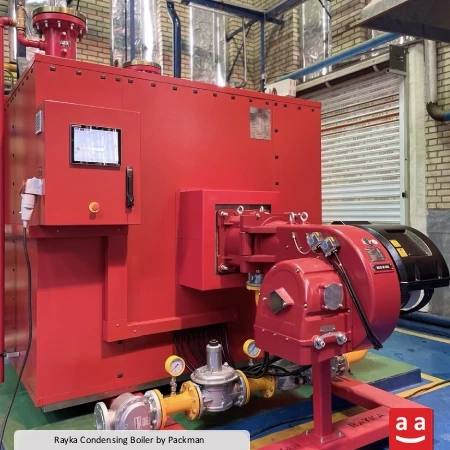
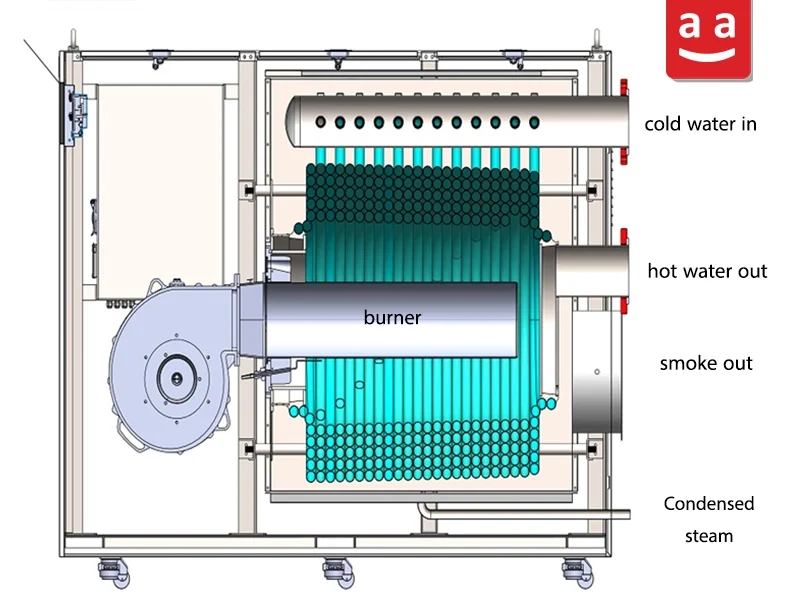
A coil-type condensing boiler is a water-tube type, where water flows inside the coils (tubes), and the combustion gases pass outside them. This boiler includes a configuration of spiral tubes through which the water flows. The water inside the coils is heated by absorbing energy from the burner flame and exits the boiler. Given the unique combustion chamber design, premixed burners are suggested for this type of boiler.
In these boilers, both premixed and nozzle mix burners can be used. Raadman Modulating Post Mixed Burners and premixed burners help reduce fuel consumption. These burners prevent the flame from contacting the boiler tubes and reduce harmful pollutants.
Rayka condensing boilers, manufactured by Packman, are of coil-type condensing boilers. Due to the design of combustion chamber, it is recommended to use gas burners for this type of boiler. Since the boiler tubes are in a direct contact with the low-temperature combustion products and have corrosive properties, it is necessary to use stainless steel tubes which are resistant to corrosion. Additionally, the stack of these boilers must be made from corrosion-resistant materials.
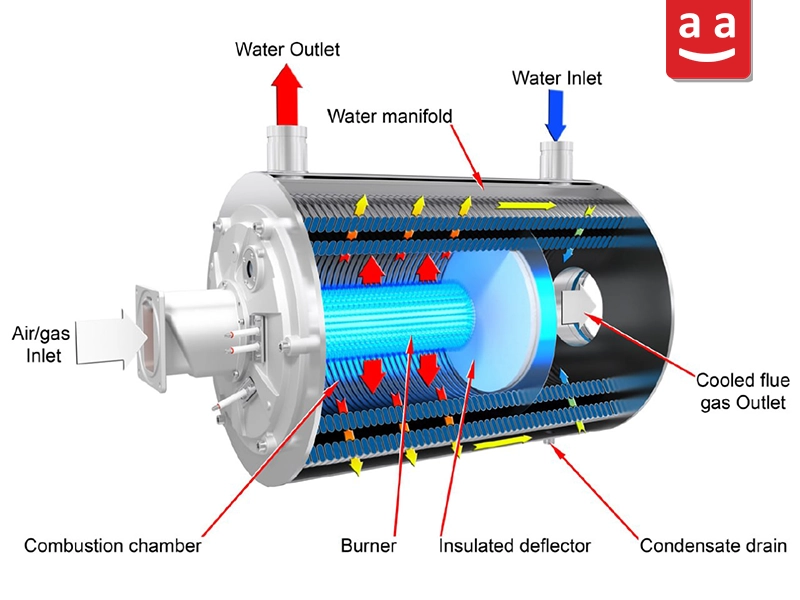
Modern coil-type condensing-boilers have a single chamber divided into two sections by a separator plate:
- Combustion Chamber: The first section houses the burner, where the combustion process takes place. Hence, the first chamber is referred to as the combustion chamber.
- Condensate Chamber: The second section, also referred to as the condensate chamber, is where the condensation process takes place. In this chamber, the latent heat of the steam is absorbed, which raises the temperature of the inlet water and ultimately improves the boiler’s efficiency.
Compact Condensing Boiler
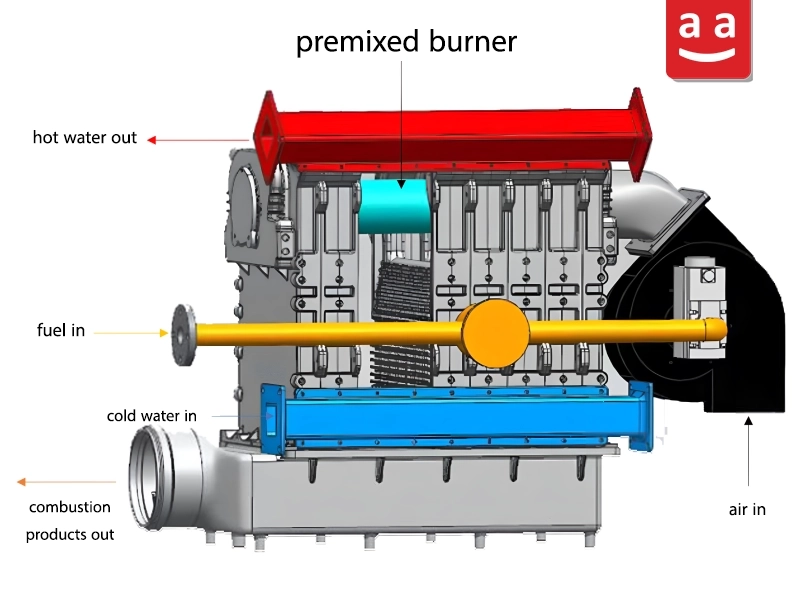
These boilers, also known as condensing heat exchangers, are a type of water-tube condensing boiler with an advanced design. The premixed burner in these boilers is positioned at the top, creating uniform combustion. The hot gases resulting from combustion pass through a series of plates and finned chambers. These fins, arranged in sequential rows, expand the contact surface between the hot gases and the plates, significantly improving the heat transfer efficiency.
Water flows through specially designed channels within the boiler. These channels are arranged in such a way that the water flow direction is perpendicular to the flow of the hot gases. This cross-flow design maximizes heat exchange, leading to a significant improvement in heat transfer efficiency and the overall performance of the boiler. Only premixed burners are used in these boilers. modulating premixed and post mixed burners, manufactured by Raadman, are a suitable choice for these boilers, complying with the latest global standards.
Fire-tube Condensing Boiler
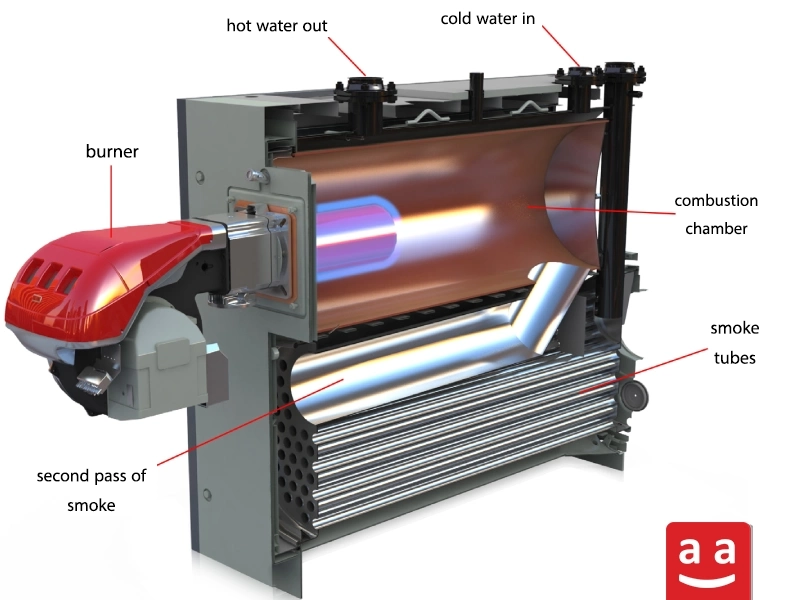
These are another types of condensing boilers, where the hot gases from combustion pass through the flue tubes (or fire tubes) and heat the water surrounding these tubes. These boilers are equipped with premixed burners and nozzle mix burners.
The combustion chamber in condensing fire-tube boilers is designed to accommodate gas burners, especially dual-fuel burners that can operate on both gas and liquid fuels. After passing through the combustion chamber, the hot combustion products enter the smoke tubes. In the smoke tubes, water vapor in the combustion products condenses. The resulting condensed vapor is then directed through an outlet to the drainage system.
The material of the smoke tubes in these boilers must be carefully selected. Due to direct contact with the acidic condensed water vapor, the typical tubes are susceptible to corrosion. Therefore, the smoke tubes must be made of corrosion-resistant stainless steel. Additionally, due to the corrosive nature of the combustion products in these boilers, the chimney material must also be resistant to corrosion.
for more information about fire tube boilers, you can read the article Introduction to Fire Tube Boilers.
Condensing Boilers Efficiency
Boiler efficiency is defined as the ratio of the useful thermal energy produced to increase the water temperature to the energy consumed from the fuel. The energy consumed from the fuel is measured based on its calorific value, which has two definitions:
- Lower Heating Value (LHV)
- Higher Heating Value (HHV)
Higher Heating Value (HHV): This refers to the condition in which the water vapor formed from combustion products is treated as liquid, thereby including the latent heat of vaporization of water. Since these boilers operate by recovering this latent heat, their efficiency should be calculated based on the higher heating value for a precise and practical assessment. This is known as gross efficiency, and it is always less than 100%.
Lower Heating Value (LHV): The claim of efficiencies exceeding 100% (or net efficiency) for condensing boilers is largely promotional. This efficiency is calculated based on the lower heating value (LHV), which does not include the latent heat of vaporization of water. For a more accurate and realistic evaluation, it is recommended to calculate the efficiency of condensing boilers based on the higher heating value (HHV), which represents the true efficiency of these boilers and can reach up to 98%.
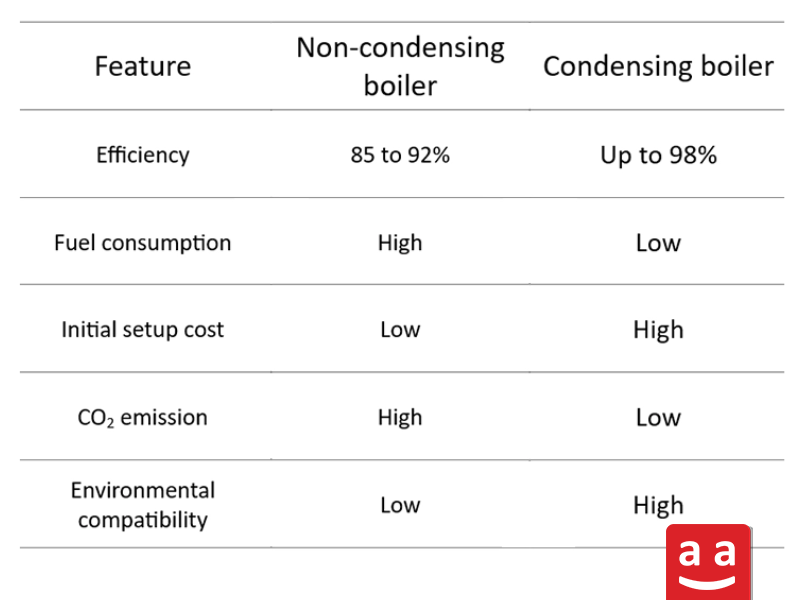
Comparison of Efficiency in Condensing and Non-Condensing Boilers
Efficiency is an important factor in the selection of boilers. Condensing and non-condensing boilers differ in design and functionality, resulting in varying efficiency levels. This study explores the efficiency of both types and the key influencing factors.
Efficiency of Non-Condensing Boilers
In non-condensing boilers, the water vapor produced during combustion is expelled along with hot gases through the stack, resulting in the loss of the latent heat of vaporization. Since these boilers cannot recover this latent energy, a portion of the fuel energy is lost in the flue gases in the stack. The thermal efficiency of these boilers is usually between 85% and 92%.
Efficiency of Condensing Boilers
Condensing boilers offer greater efficiency compared to non-condensing boilers, as they can reclaim the latent heat from water vapor that would otherwise be lost. During combustion, water vapor condenses, and its latent heat is redirected back into the system. This latent heat is transferred to the inlet water, heating it. The recovery of this latent heat has caused the efficiency of these boilers to reach 98%. Therefore, condensing boilers lose less energy in the flue gases and improve the overall system efficiency.
Condensing Boiler Applications
Two common applications of condensing-boilers are underfloor heating and pool water heating. Additionally, they play a crucial role in laundries, supply hot water for healthcare facilities, support the food industry, and provide heating for greenhouses.
Underfloor Heating
Condensing boilers, known for their high efficiency and capability to operate at lower temperatures, are an ideal choice for underfloor heating systems in buildings. In such systems, hot water circulates through the pipes embedded in the floor, gradually transferring heat to the surrounding area. Since the heating temperature is lower than the dew point of the combustion products, condensing boilers provide a suitable solution.
Another major challenge when replacing heating systems in old buildings with newer systems, such as underfloor heating, is selecting the appropriate boiler size. Due to the compact design of condensing boilers, choosing a suitable condensing boiler can effectively address this issue.
Pool Water Heating
These boilers are frequently used in heating swimming pool water because of their superior efficiency. They recover latent heat from the combustion gases, making them an energy-efficient option for pool heating. Additionally, their capability to operate at lower temperatures ensures that pool water is heated effectively while minimizing energy usage.
Condensing Boilers; An Optimal Solution for Heat Supply
As one of the most advanced heating systems, condensing boilers stand out for their high efficiency and reduced fuel consumption, making them an ideal choice for various industries. By utilizing the latent heat of water vapor, these boilers help reduce fuel consumption, energy costs, and emissions of pollutants. Packman, a reputable manufacturer of condensing-boilers, assists industrialists in achieving efficient and sustainable heating systems by offering high-quality products and innovative designs. With a long-standing reputation in design and production of condensing boilers, Packman company offers solutions tailored to the specific requirements of its customers.
Frequently Asked Questions (FAQ) about Condensing Boilers
What is a condensing boiler and how does it work?
A condensing boiler is an advanced boiler that recovers the latent heat from water vapor in combustion gases, increasing efficiency. When the exhaust gases cool below the dew point, the vapor condenses into liquid, releasing heat to the water inside the boiler. This process allows the boiler to produce more heat with less fuel, achieving up to 98% efficiency.
Do condensing boilers require special maintenance?
Yes, condensing boilers require regular maintenance, similar to standard boilers, but with extra attention to the condensate drain and heat exchanger. Keeping these components clean prevents blockages and corrosion, ensuring the boiler stays efficient and long-lasting.
What are the benefits of a condensing boiler over a conventional boiler?
Condensing boilers are more energy-efficient than standard boilers because they capture extra heat from exhaust gases that would otherwise be lost. This leads to lower fuel consumption and reduced heating costs. They also produce fewer greenhouse gas emissions, making them a more environmentally friendly option.
What types of burners are more suitable for condensing boilers?
Premixed burners are most suitable because they thoroughly mix fuel and air before combustion, producing a more uniform and controlled flame with lower exhaust temperatures — a key requirement for condensing boilers to condense the water vapor in the flue gases. This helps the boiler achieve high efficiency and stable operation over time.