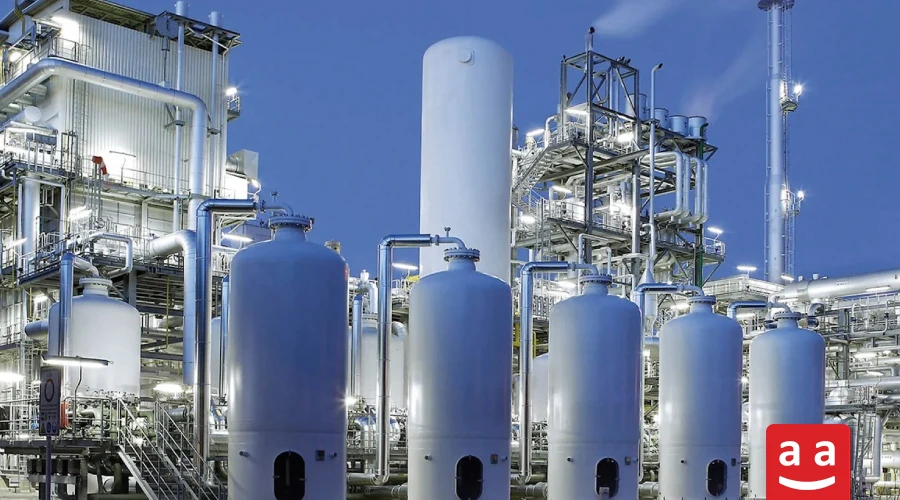
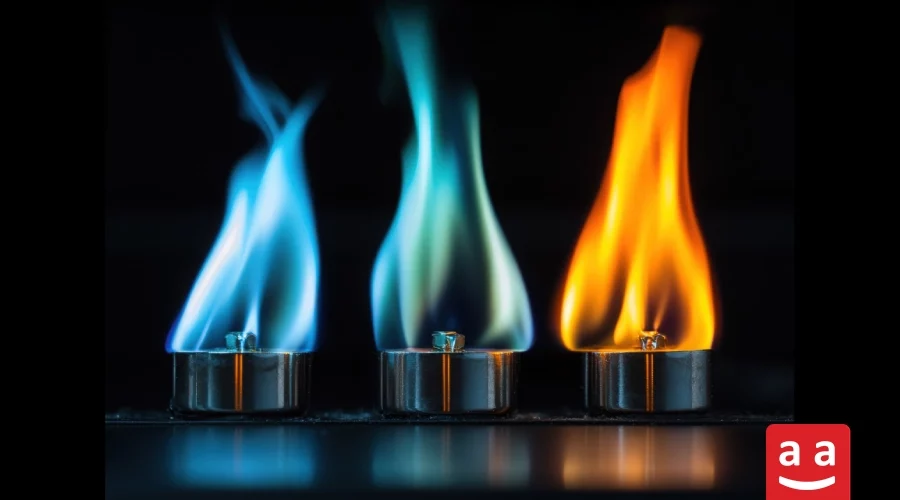
As a fundamental process, combustion is essential for providing the energy required in both daily life and industrial applications. A solid understanding of its basic principles is crucial for optimizing and controlling combustion effectively. Chemistry forms the foundation of this process, offering the framework to explain how combustion occurs. Therefore, reviewing and emphasizing the core chemical concepts discussed below is key to gaining a deeper understanding of combustion.
What is Combustion?
Combustion simply means burning. It is a chemical process in which a fuel reacts with oxygen to produce energy. This reaction produces heat and, in many cases, visible light. In the simplest terms, whenever heat is generated by burning a material—such as when a gas stove is working or a car engine is running—combustion is taking place.
It is important to note that combustion does not occur automatically. For the reaction to start, the fuel must reach a certain minimum temperature known as its ignition temperature. Below this temperature, the fuel will not burn, even in the presence of oxygen. Once this threshold is reached, the chemical reaction begins, releasing energy.
Combustion is therefore one of the most fundamental processes behind modern energy systems—from household heating and cooking to power generation and transportation.

Types of Combustion
Combustion can take many forms, each with distinct characteristics. The types listed below represent the most common classifications:
Smoldering Combustion
Smoldering combustion is a low-temperature, flameless oxidation process. It usually occurs in solid fuels such as wood, biomass, and coal.
Rapid Combustion
Rapid combustion is a type of combustion in which fuel reacts very quickly with oxygen, producing a large amount of heat and light in a short period of time. This type of combustion is responsible for most of the flames we see in daily life, such as in candles, stoves, and simple burners.
Explosive combustion
Every rapid combustion in confined or restricted spaces, leading to sudden release of large amounts of heat, light, gas expansion, and often a pressure wave.

Spontaneous Combustion
Ignition occurs without any external flame or spark. Certain materials self-heat through slow oxidation or chemical reactions until ignition occurs. For example, compost piles can spontaneously catch fire if heat accumulates over time. Similarly, coal piles in storage may ignite under certain conditions without any external source of ignition.
Complete Combustion
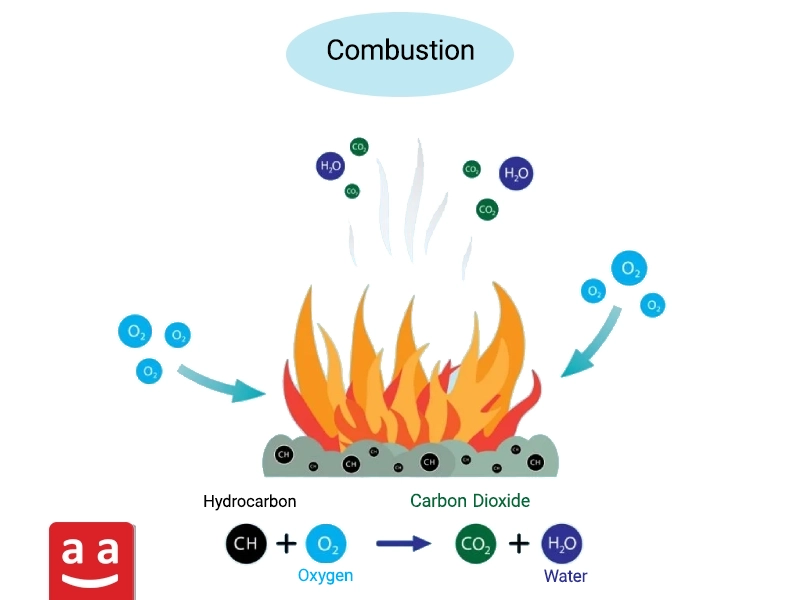
Complete combustion occurs when a fuel burns in sufficient oxygen, producing mainly carbon dioxide (CO₂) and water (H₂O). It releases the maximum possible energy with minimal pollutants compared to incomplete combustion.
Incomplete Combustion
Incomplete combustion happens when there is not enough oxygen or proper mixing. Incomplete combustion occurs when there is insufficient oxygen, resulting in partially burned fuel and the production of carbon monoxide, soot, or unburned hydrocarbons. This process releases less energy than complete combustion.

Premixed Combustion
In premixed combustion, fuel and air are thoroughly mixed before ignition, usually triggered by a spark. The flame forms at the ignition point and propagates through the mixture, with the boundary between burned and unburned regions called the flame front. Combustion is intense at the flame front and moves at a relatively fixed speed.
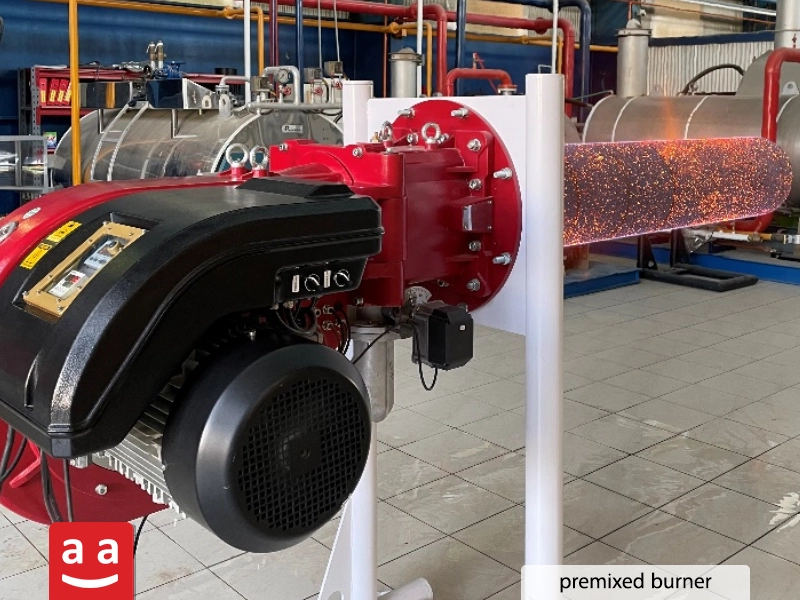
Premixed combustion is applied in Raadman PE series burners, here fuel and air are mixed before entering the combustion chamber. This design improves efficiency and significantly reduces pollutants like CO and NOx.
Diffusion Combustion
In diffusion combustion, fuel and oxidizer are supplied separately and mix only at the point of combustion. Ignition occurs as the fuel molecules diffuse into the oxidizer, and the flame intensity depends on the quality of mixing.
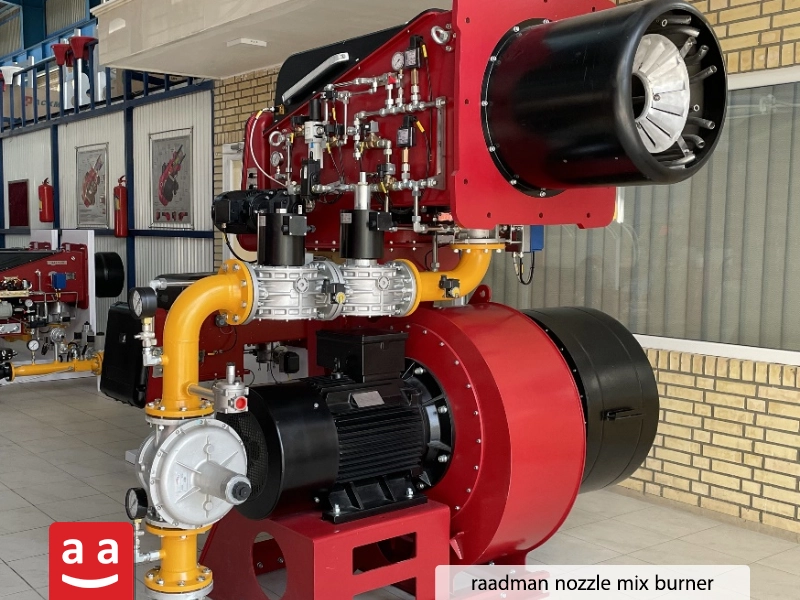
Diffusion combustion is used in nozzle mix burners, where fuel and air remain separate until exiting the nozzle. Advanced nozzle mix burners by Raadman are built to meet international standards, ensuring efficient mixing, stable combustion, lower fuel consumption, and reduced pollutant emissions.
Laminar Combustion
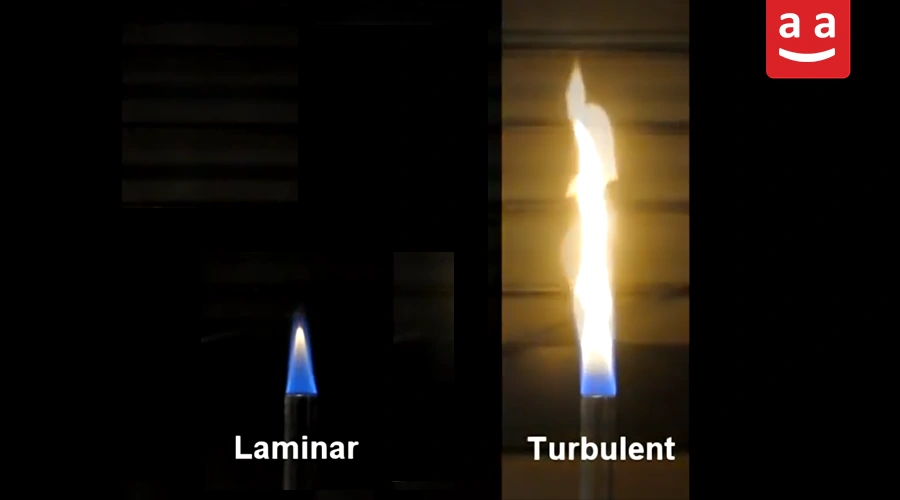
Laminar combustion occurs under low flow velocities where fuel and oxidizer move in smooth, orderly layers without significant turbulent mixing. The flame front is stable and the reaction rate is primarily controlled by molecular diffusion and chemical kinetics.
Turbulent Combustion
This type of combustion occurs in flows where fuel and oxidizer mix irregularly due to turbulence. This enhances mixing and increases the reaction rate, leading to faster and more intense burning compared to laminar flows. It is the dominant combustion mode in most industrial burners, furnaces, and gas turbines.
The classifications mentioned are based on different criteria, including reaction speed, mixing of fuel and oxidizer, completeness of reaction, and flow regime (laminar or turbulent). In real combustion systems, a single combustion process can belong to multiple categories at the same time. For example, a flame can be both rapid and turbulent, or premixed and complete, depending on operating conditions.
Process of Combustion
This process is fundamentally an oxidation process in which the oxidizable components of fuel react, and this can be represented by a chemical equation. Throughout this process, the mass of each element remains unchanged, making it essential to adhere to the law of conservation of mass in all reactions. According to Equation 1, the simplest type of reaction is the one that occurs between carbon and oxygen.
Equation 1
C + O2 → CO2
This equation states that 12 kilograms (equivalent to one kilomole) of carbon react with 32 kilograms (equivalent to one kilomole) of oxygen to produce 44 kilograms (equivalent to one kilomole) of carbon dioxide. The substances participating in the reaction are known as reactants, while the resulting compounds are called products. The general form of a combustion reaction is expressed by the next equation.
Equation 2
Fuel + Oxidizer → Water Vapor + Carbon Oxides + Nitrogen + Energy
Combustion reactions primarily produce water vapor and carbon dioxide as their main products. The physical state of water—whether liquid or vapor—depends on the temperature and pressure of the products. In most practical cases, instead of using pure oxygen as the oxidizer, a specific amount of air is used.
The molar composition of air consists of 21% oxygen, 78% nitrogen, and 1% argon and other gases. In combustion calculations, argon and other trace gases are typically neglected, and it is assumed that air is composed of 21% oxygen and 79% nitrogen on a molar basis. Under this assumption, for each mole of oxygen in the air, 3.76 moles of nitrogen are present.
The article Clean Combustion offers an in-depth discussion on clean fuels. It is suggested to read this article for further details.
Theoretical (Stoichiometric) Air and Excess Air
The minimum required air for the complete process is referred to as theoretical or stoichiometric air. When combustion occurs with the exact stoichiometric air, no excess oxygen is found in the products. This reaction is expressed in Equation 3.
Equation 3

The stoichiometric coefficients in Equation 3 can be obtained using the principles of balancing. These coefficients are provided in Table 1.
![\[ \Large % تغییر سایز به بزرگتر \renewcommand{\arraystretch}{2} % افزایش فاصلهی عمودی برای وسطچین شدن متن \begin{array}{|c|c|} \hline \multicolumn{1}{|c|}{x + \frac{y}{4}} & \multicolumn{1}{c|}{v_{O_2}} \\ % وسطچین \hline \multicolumn{1}{|c|}{x} & \multicolumn{1}{c|}{v_{CO_2}} \\ % وسطچین \hline \multicolumn{1}{|c|}{\frac{y}{2}} & \multicolumn{1}{c|}{v_{H_2O}} \\ % وسطچین \hline \multicolumn{1}{|c|}{3.76\left(x + \frac{y}{4}\right)} & \multicolumn{1}{c|}{v_{N_2}} \\ % وسطچین \hline \end{array} \]](https://raadmanburner.com/wp-content/ql-cache/quicklatex.com-264d5417fde2ab626eb820683851cbba_l3.png "Rendered by QuickLaTeX.com")
Table 1- Stoichiometric coefficients of combustion reaction
Therefore, to completely combust one mole of a hydrocarbon fuel with a specified chemical formula, (x + y/4) × 4.76 moles of air are required. This corresponds to 100% stoichiometric air. However, in practice, complete combustion occurs when the amount of air supplied is slightly higher than the theoretical air requirement. To calculate the excess air required for combustion, two parameters, AF and λ, are introduced. The AF parameter refers to the air-to-fuel ratio and is defined in Equations 4 and 5, in terms of mass and moles, respectively.
Equation 4
![\[ AF_{mass} = \frac{m_{air}}{m_{fuel}} \]](https://raadmanburner.com/wp-content/ql-cache/quicklatex.com-02b9280f62162f5e9d74c875fdac945e_l3.png "Rendered by QuickLaTeX.com")
Equation 5
![\[ AF_{mole} = \frac{n_{air}}{n_{fuel}} \]](https://raadmanburner.com/wp-content/ql-cache/quicklatex.com-776421eb0ff00ab9773bbfa8ed9423c4_l3.png "Rendered by QuickLaTeX.com")
The equivalence ratio of ϕ is defined by Equation 6 as the ratio of the stoichiometric air-to-fuel ratio divided by the actual air-to-fuel ratio.
Equation 6
![\[ \phi = \frac{AF_s}{AF_a} \]](https://raadmanburner.com/wp-content/ql-cache/quicklatex.com-1fa614365a75044112625201947c5f9e_l3.png "Rendered by QuickLaTeX.com")
If ϕ < 1, the fuel mixture is considered lean in terms of fuel and the combustion process has excess air. If ϕ > 1, the mixture is considered rich in fuel. The actual amount of air used can be expressed by the excess air percentage λ, as given in Equation 7.
Equation 7

The subscript “s” refers to the value of the parameter in the stoichiometric state. The application of 20% excess air (%λ = 20) is commonly used in industrial combustion.
Pollutants Resulting from Combustion
As mentioned, complete combustion in industry occurs when the amount of air supplied is slightly greater than the stoichiometric air requirement. Incomplete process results in by-products that act as combustion pollutants. The most important and notable pollutants of this process are carbon monoxide and nitrogen oxides (NOx). Adjusting the level of excess air allows for the control of pollutants. The following figure illustrates the production of carbon monoxide and NOx pollutants based on the air-to-fuel ratio in a combustion process.
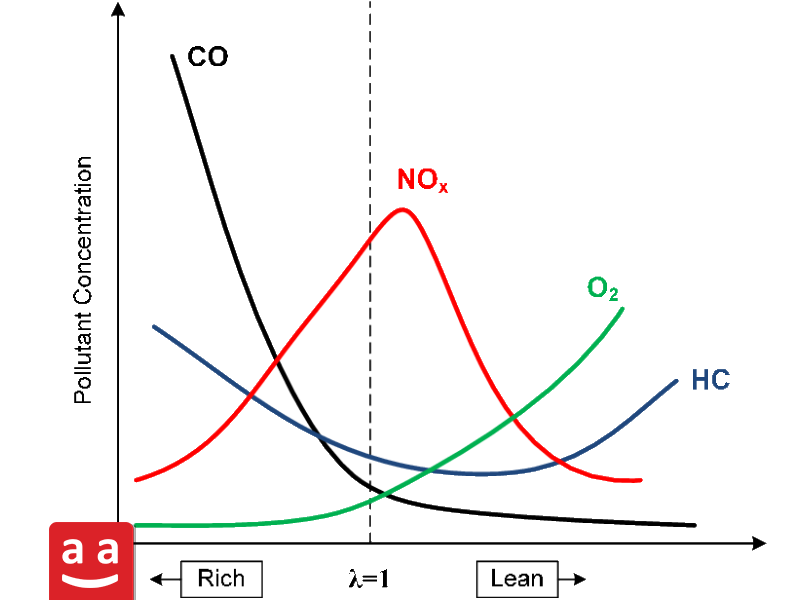
NOx emission is highest near the stoichiometric air-to-fuel ratio, and as the air-to-fuel ratio decreases, NOx production decreases while carbon monoxide emissions rise. By increasing the excess air relative to the stoichiometric air, both carbon monoxide and NOx emissions will decrease simultaneously. However, excessive increase in this ratio leads to a decrease in flame temperature and an increase in stack losses, both of which lower efficiency. Hence, an optimal amount of excess air should always be considered in every combustion process.
Emissions Caused by Nitrogen
The presence of nitrogen oxides in the atmosphere leads to the formation of smog, acid rain, global warming, and damage to the ozone layer. The key nitrogen oxide compounds are nitrogen monoxide (NO), nitrogen dioxide (NO2), and nitrous oxide (N2O).
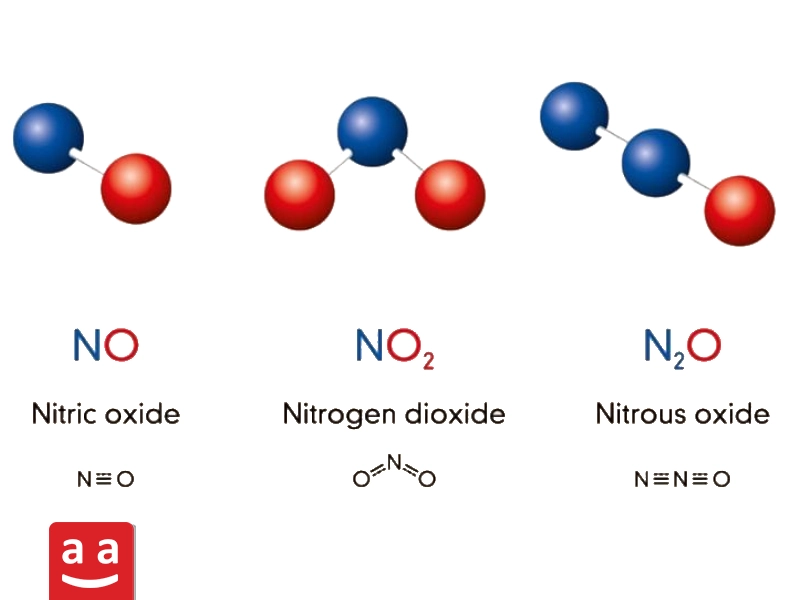
There are three primary mechanisms for the formation of nitrogen oxides in combustion reactions which lead to: thermal NOx, prompt NOx, and fuel NOx.
Thermal NOx is mainly formed at high temperatures and in the presence of large amounts of nitrogen and oxygen. Under such conditions, nitrogen molecules decompose due to the high temperatures and combine with oxygen.
This type of NOx is the most prevalent in most combustion processes, especially in industrial equipment such as boilers, gas turbines, and internal combustion engines. Prompt NOx is generated by the reactions of free radicals produced during combustion. These reactions usually take place in the initial stages and result in the formation of unstable nitrogen compounds, which rapidly transform into nitrogen oxides.
Fuel NOx forms when nitrogen compounds in the fuel chemical structure break down during combustion, and the released nitrogen atoms react with oxygen. This type of NOx is notably produced in substantial amounts in liquid and solid fuels like fuel oil and coal. Its quantity depends on the chemical composition of the fuel, conditions, and flame temperature.
Carbon Monoxide (CO) Emission
Carbon monoxide (CO) is generally produced as an incomplete combustion product in a few combustion processes. It is a flammable, colorless, odorless, tasteless, and generally non-corrosive gas. Carbon monoxide is found in all combustion products of carbon-based fuels. In equilibrium, carbon monoxide is formed according to Equation 8.
Equation 8
CO2 → CO + 0.5O2
Carbon monoxide concentration is influenced by temperature and excess air. In fuel-rich combustion areas, the carbon monoxide level rises due to insufficient oxygen. Only when enough air is mixed with the fuel at high temperatures does the carbon monoxide level decrease. In combustion with low fuel levels, carbon monoxide will combine with air to form carbon dioxide molecules.
Carbon monoxide is primarily produced from the incomplete combustion of a hydrocarbon fuel. In a fuel-lean system, excess oxygen is used to ensure complete process and minimize carbon monoxide emissions. The figure below shows the air-to-fuel ratio in the combustion process and the amount of carbon monoxide emissions. In this graph, the horizontal axis represents the air-to-fuel ratio in the combustion process, with a value of one considered as the stoichiometric air-to-fuel ratio.
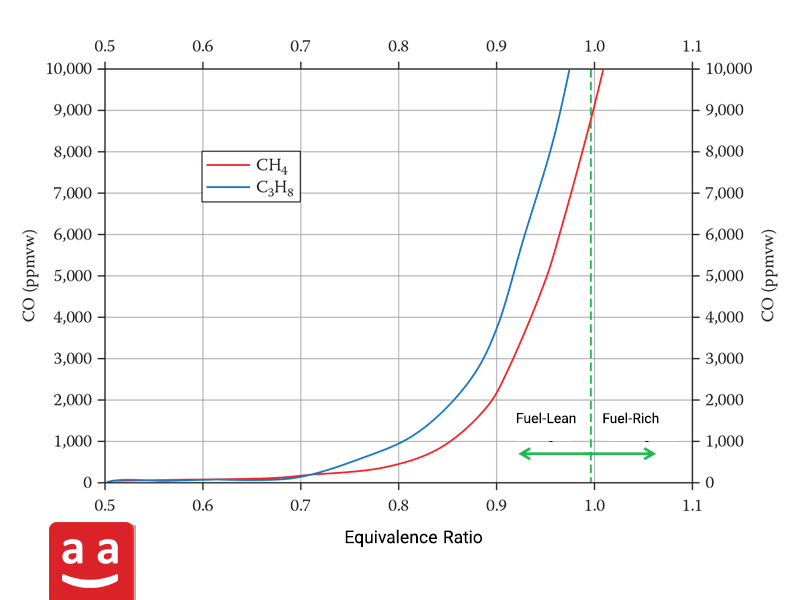
Raadman burners, with their precise engineering design, are capable of operating with low excess air, resulting in increased combustion efficiency, reduced emissions, and optimized fuel use. To precisely control the excess air amount, CO/O₂ Trim sensors like those from AutoFlame can be employed. These systems continuously monitor the levels of oxygen and carbon monoxide in the exhaust gases and use a smart controller to adjust the air-to-fuel ratio.
Adiabatic Temperature of Flame
When there are no heat losses, the temperature of the products reaches its highest value, known as the adiabatic flame temperature. The figure below illustrates the adiabatic flame temperature for hydrogen, methane, and propane fuels in terms of the equivalence ratio.
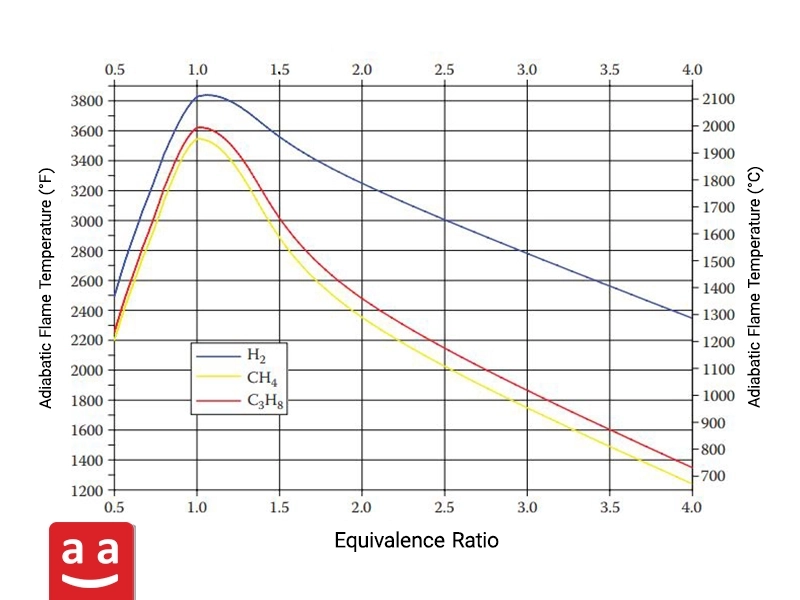
The peak temperature (maximum temperature) for fuels in the figure above occurs under conditions close to stoichiometric. In many real flames, the maximum temperature occurs under lean fuel conditions. This is carried out to avoid incomplete process, which requires additional oxygen to complete the process. Almost all industrial applications operate in lean fuel conditions to ensure that carbon monoxide levels remain low. Thus, with proper burner design, the flame temperature can approach the peak temperature (the condition that optimizes heat transfer).
The highest temperature that a combustion chamber can withstand depends on the material of the chamber. As a result, the adiabatic flame temperature plays a critical role in the design of combustion chambers for gas turbines, boilers, etc. In Table 2, the adiabatic flame temperature for several fuels is provided.
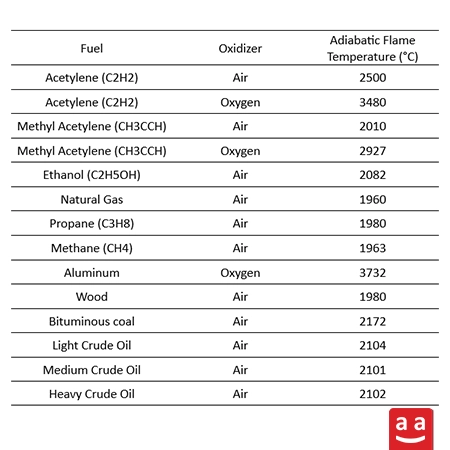
One of the key challenges in high-temperature flames is the maximization of NOx formation. The production of thermal NOx increases exponentially with temperature, which is why many modern designs focus on reducing flame temperature to minimize NOx emissions. In this regard, Raadman burners with their advanced design achieve optimal fuel and air distribution, preventing the formation of high-temperature zones and, as a result, minimizing NOx production.
Advances in Combustion Science
Combustion science has evolved significantly, leading to improved efficiency, cleaner burning, and better control of flame behavior. The following advances highlight key developments in the field:
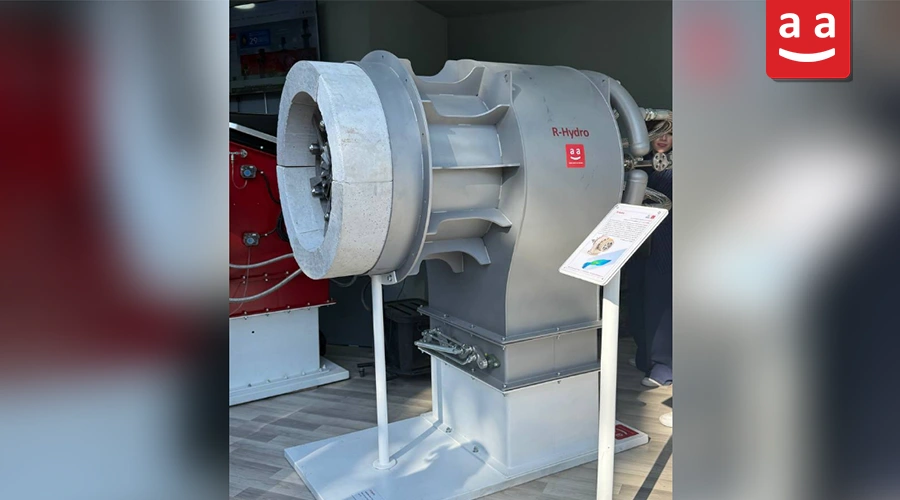
Hydrogen Combustion: Advances in hydrogen combustion technologies are making flames safer, more stable, and highly efficient. These developments apply to a wide range of systems, from industrial burners and laboratory setups to aerospace engines, while significantly reducing harmful emissions.
Raadman is proud to introduce its new hydrogen burner, capable of safely burning 100% hydrogen. This innovative solution delivers high efficiency, stable performance, and ultra-low emissions for industrial applications. Discover the full story in our Latest Developments section: R-Hydro Burner.
Smart Control Systems: Advanced control systems continuously regulate fuel flow, air supply, and flame conditions in real time. This leads to steadier combustion, higher efficiency, optimized fuel usage, and noticeably lower emission levels in industrial combustion.
Alternative Fuels: Alternative fuels enable burners and engines to operate using cleaner, more sustainable fuels such as hydrogen, biofuels, and synthetic fuels. This advanced approach reduces greenhouse gas emissions, lowers reliance on fossil fuels, and ensures efficient, stable, and environmentally friendly performance across industrial and energy systems.
Premixed combustion: Premixed combustion thoroughly mixes fuel and air before ignition, resulting in more complete burning and higher efficiency. This approach significantly reduces nitrogen oxide (NOx) emissions compared to conventional flames.
Ultra-Low-NOx combustion: Ultra-Low-NOx combustion systems are designed to drastically reduce nitrogen oxide emissions while maintaining efficient and stable operation. Burners that utilize this technology achieve low emissions through optimized fuel and air mixing, and staged or distributed combustion zones that prevent high-temperature points within the flame. These burners are widely used in boilers and petrochemical furnaces such as fired heaters providing cleaner combustion while maintaining reliable performance.
Concluding Remarks; Efficient Combustion with Advanced Industrial Burners
Industrial burners are vital in optimizing the combustion process and minimizing environmental pollutants. Understanding the principles of this process, including stoichiometric ratios, adiabatic flame temperature, and the mechanisms of pollutant formation such as NOx and CO, is essential for designing efficient combustion systems. Accurate control of excess air and the implementation of modern burner technologies can significantly enhance combustion efficiency and reduce emissions.
In this context, Raadman burners, with their advanced design, facilitate optimal fuel and air mixing, which not only enhances combustion efficiency but also contributes to the reduction of environmental pollutants. This technology improves flame temperature control and prevents excessive heat zones, reducing the formation of pollutants like NOx. As a result, applying engineering expertise and advanced burner design technologies is a highly effective strategy for minimizing environmental impact and achieving optimal, sustainable combustion.