
A Rotary Cup Burner is a mechanical combustion system that uses the centrifugal force generated by a rotating cup to atomize heavy and contaminated liquid fuels, such as fuel oil (mazut) into fine droplets without the need for high-pressure fuel pumps. If you are facing challenges such as declining fuel quality, high fuel viscosity, or frequent nozzle clogging in industrial boilers or marine applications, rotary cup burners can be an effective solution
Contrary to a common misconception, rotary cup burners are used exclusively for liquid fuels and have no practical application for gaseous fuels such as natural gas or LPG. In this comprehensive guide by Raadman, we will explore the working principle, key components, applications, advantages, and characteristics of rotary cup burners.
To learn more about the different types of industrial burners, their applications, and the criteria for selecting the right burner for your system, explore our comprehensive Industrial Burner Guide.
What Is a Rotary Cup Burner?
A Rotary Cup Burner is a type of heavy-oil burner that uses a high-speed rotating cup, typically operating between 3,000 and 12,000 rpm, to atomize fuel, eliminating the need for conventional pressure nozzles and high-pressure fuel pumps. In this system, liquid fuel is fed into a rapidly rotating metal cup, where centrifugal force spreads it into an ultra-thin film across the cup’s surface. As the fuel reaches the cup’s edge, it is discharged as extremely fine micron-sized droplets, creating highly efficient atomization. The atomized fuel then mixes with primary and secondary combustion air to produce a stable, short, and cone-shaped flame.
It is also important to note that rotary cup burners can operate on oil (diesel fuel). However, due to the specialized components required for this technology, their use in diesel-fired applications is generally not considered cost-effective. Moreover, the dual-fuel rotary cup burners can operate with gas fuel. In gas-firing mode, combustion is achieved through dedicated gas nozzles installed within the combustion head. These nozzles operate independently of the rotating cup, which means the cup atomization system is used only for liquid fuels and has no function during gas-fired operation.
Although rotary cup burners can also operate on oil (diesel fuel), most projects prefer the specific oil burners instead. To better understand their structure, operating principle, and selection criteria, we recommend reading the article of oil burner.

Operation of a Rotary Cup Burner
The rotary cup burner operates by using centrifugal force to atomize fuel into extremely fine droplets without requiring high pressure. The process consists of the following steps:

1- Fuel Entry into the Rotating Cup
After passing through a filter and a preheater (if required), the fuel is injected at low pressure (typically 2 to 5 bar) through a central tube onto the inner surface of the rotating metal cup.
2- Atomization by Centrifugal Force
The rotating cup spins at high speed (3,000 to 12,000 rpm) driven by an electric motor. Under the effect of centrifugal force, the fuel is forced to the inner surface of the cup, spreads into an extremely thin film, and is thrown off from the cup edge. At this stage, centrifugal force breaks the fuel into fine droplets ranging from 20 to 150 microns. In general, the higher the rotational speed of the cup, the finer the resulting droplet size.
3- Primary Air
A portion of air (approximately 15–25% of the total combustion air) is supplied at relatively high pressure and flows through passages around the rotating cup. In addition to providing part of the combustion air, this airflow performs two important functions:
- It further atomizes the fuel, producing finer and more uniform droplets.
- It accelerates and shapes the fuel spray into a stable hollow cone pattern directed toward the combustion zone.
4- Secondary Air
The remaining combustion air (approximately 75–85%) is introduced into the combustion chamber through air inlets and adjustable dampers. After hitting the fuel cone, it completes the combustion process.
5- Combustion and Flame Formation
In order to initiate the combustion, an electric spark or a pilot burner is activated to ignite the air–fuel mixture. The result is a stable, relatively short, cone-shaped and steady flame.

Components of a Rotary Cup Burner
A rotary cup burner contains the same standard components found in conventional liquid-fuel burners, including a fuel pump, solenoid valves, a control panel, a combustion air fan, a pilot burner, and others.
However, due to its unique fuel atomization method, it does not use a high-pressure pump or a traditional nozzle. Instead, it incorporates several specialized components that enable the rotary cup atomization process, which are introduced below:
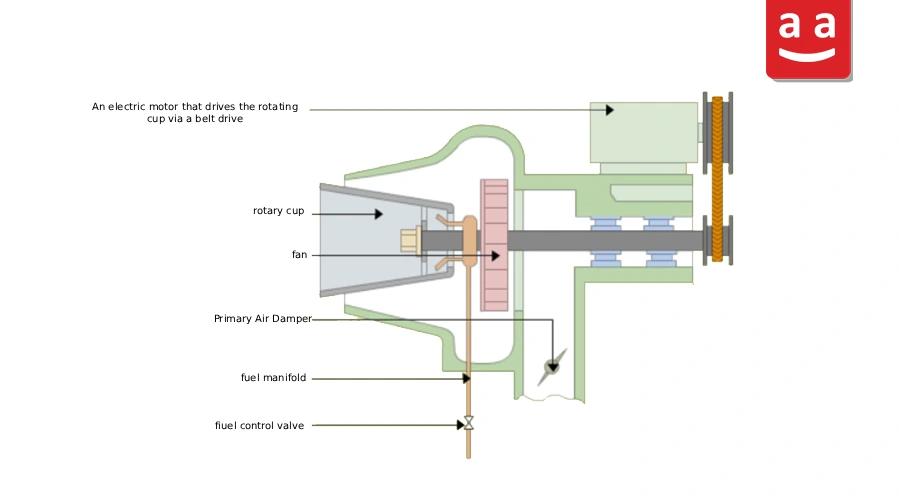
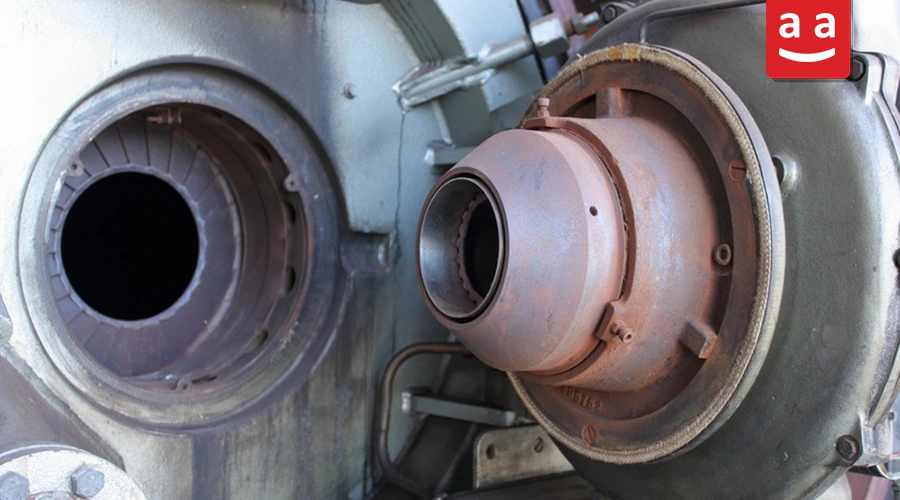
Rotating Cup
The rotating cup is the main component of the burner. It is typically cylindrical or slightly conical in shape and is made of stainless steel. As previously explained, its function is to atomize the fuel into extremely fine droplets using centrifugal force, ensuring stable and uniform combustion.
Cup Drive Motor
This small electric motor typically has a power rating of 0.3 to 1.5 kW and operates at high speed (3,000–12,000 rpm). Its high rotational speed ensures efficient fuel atomization and the formation of fine droplets.
Shaft & Coupling
The shaft transmits rotational motion from the motor to the rotating cup, connecting the cup assembly to the motor and enabling stable high-speed rotation.
Fuel Tube
The fuel tube delivers fuel to the center of the rotating cup and injects it directly into the cup.
Industrial Applications of Rotary Cup Burners
As mentioned earlier, rotary cup burners are a relatively older technology. Their primary application is the combustion of heavy and low-quality liquid fuels such as fuel oil (mazut), and they have no functionality with gaseous fuels. Today, due to improvements in liquid fuel quality and advances in alternative atomization technologies, the use of this type of burner is no longer economically justified in most industries, although it is still applied in certain cases.
The main applications of these burners are in industrial units that rely on heavy liquid fuels, such as:
- Industrial Boilers: In industrial boilers that use heavy liquid fuels such as fuel oil (mazut), rotary cup burners can be considered one of the available options.
- Marine Boilers and Ship Applications: A significant portion of rotary cup burner applications is found in the marine and offshore sectors. These burners are commonly used in oil tankers, bulk carriers, LNG carriers, and floating production storage and offloading units (FPSO/FSO). In many of these vessels, auxiliary boilers are equipped with rotary cup burners. The widespread use of high-viscosity, variable-quality heavy fuels in the marine industry, combined with the burner’s ability to maintain stable combustion under harsh operating conditions, has been a key factor in the selection of rotary cup burner technology in this sector.
- Industrial Furnaces: Rotary cup burners can be used in various industrial furnaces that operate on heavy liquid fuels such as fuel oil (mazut), provided that the burner operating conditions are fully compatible with the furnace requirements.

Advantages of Rotary Cup Burners
The main advantages of rotary cup burners, which explain why this relatively older technology is still used in some industries, include the following:
- Fuel flexibility: Rotary cup burners have fewer limitations in terms of fuel density and viscosity compared to modern pressure atomization systems. They are capable of burning heavy fuels, enabling the use of a wider range of more economical fuel options.
- Reduced risk of fuel nozzle clogging: The fuel passages and injection openings in rotary cup burners are significantly larger than those in pressure-atomizing burners, making them less prone to clogging. This is particularly important when low-quality fuels are used.
It should be noted that the extent to which these advantages are realized depends on operating conditions, burner settings, equipment condition, and the characteristics of the fuel used.
Disadvantages of Rotary Cup Burners
The main disadvantages and limitations of rotary cup burners include the following:
- Complex design and multiple moving parts: These burners have a more complex mechanical structure and include more moving components, which can increase maintenance requirements.
- Higher vibration and noise levels: Due to the high-speed rotating cup, these burners typically generate more vibration and operational noise.
- Higher cost: The initial purchase cost is generally higher than other liquid-fuel burners with pressure, steam, or air atomization systems. In addition, maintenance and repair can be more complex and costly due to the number of moving parts.
- Limited economic advantage to heavy fuels: Rotary cup burners are not economically suitable for light and clean liquid fuels. They are also less favorable in applications requiring dual-fuel operation (liquid and gas).
- Larger size: These burners are generally bulkier, making them less suitable for installations where compact design and space optimization are required.
Rotary Cup Burners: A Proven Solution for Heavy Fuel Combustion
The rotary cup burner is one of the oldest liquid-fuel atomization technologies still in use today. Thanks to its ability to handle heavy, high-viscosity fuels, it remains a practical solution for certain industrial applications. By utilizing a high-speed rotating cup instead of conventional fuel nozzles, this burner is less susceptible to fuel passage blockages and can maintain stable combustion even when fuel quality is inconsistent. The technology is specifically designed for liquid fuels, particularly those requiring atomization due to their high viscosity, and has no application in gas-fired combustion.
However, the greater mechanical complexity, higher maintenance requirements, and continued advancement of alternative atomization technologies have reduced the use of rotary cup burners in many industries. Today, they are primarily found in facilities that rely on heavy liquid fuels such as fuel oil (mazut), as well as in the marine and shipping sectors, where the use of such fuels remains common.
Ultimately, the selection of a rotary cup burner should be based on fuel characteristics, operating conditions, maintenance requirements, and overall economic considerations. When properly matched to the application, rotary cup technology can provide reliable operation and higher efficiency.
FAQ about Rotary Cup Burners
What is a rotary cup burner and how does it work?
A rotary cup burner is an industrial burner designed primarily for heavy, high-viscosity liquid fuels. Fuel is fed into a high-speed rotating cup, where centrifugal force atomizes it into fine droplets for efficient combustion. This atomization method helps reduce common issues such as fuel passage clogging and flame instability, making rotary cup burners particularly suitable for challenging fuel applications.
What types of fuel can be used in a rotary cup burner?
Rotary cup burners are primarily designed for heavy liquid fuels such as fuel oil (mazut). Their centrifugal atomization mechanism enables efficient fuel atomization and stable combustion, even with high-viscosity fuels. Although rotary cup burners can also operate on oil (diesel fuel), they are generally not considered economically viable for this application due to the specialized equipment required. As a result, dedicated oil burners (diesel-fired) burners are typically preferred for these systems.
How is a rotary cup burner maintained?
Rotary cup burners do not require particularly complex maintenance procedures. Routine servicing typically involves cleaning the fuel passages and the rotating cup to prevent deposits from affecting atomization performance.