
Growing energy demand and environmental concerns have made efficient, low-emission combustion increasingly important. Premixed burners offer an effective solution by improving combustion efficiency and reducing harmful emissions. This article explores their working principle, structure, advantages, and industrial applications.
What Is a Premixed Burner?
A premixed burner is a type of industrial burner in which fuel and air are precisely mixed before entering the combustion chamber. This mixing process enables the burner to operate more efficiently and effectively while helping reduce emissions and energy consumption. Premixed burners are considered an advanced combustion technology, as they provide optimized combustion through precise fuel–air mixing, resulting in significantly lower emissions and improved energy efficiency.
You can explore Raadman’s range of premixed burners in various capacities, along with a purchasing guide and after-sales services, on the Premixed Burner page.
Types of Burner Combustion
The combustion process is scientifically and technologically categorized into three types:
- Premixed Combustion: In this method, fuel and air are mixed before the burner head. A chemical reaction occurs between fuel and air at the flame formation place. This technology is used in premixed burners.
- Nozzle mix Combustion: In nozzle mix or non-premixed combustion, fuel and air are completely separate before they reach the burner head. They come into contact and react at the flame formation place. The flame formed by this method is also known as a diffusion flame. This method is used in nozzle mix burners for burning fuel.
- Partially-Premixed Combustion: This method lies between the two previous types, whereby part of the combustion occurs as premixed and part occurs as non-premixed.
Advantages and Disadvantages of Lean Premixed Combustion
Lean premixed combustion is an advanced combustion technology that optimizes performance by precisely controlling the fuel-to-air ratio. It is widely used in gas turbines and premixed burners, offering several benefits, particularly in reducing emissions. In this process, the air-to-fuel ratio is higher than the stoichiometric ratio, creating a lean mixture. This helps lower flame temperatures and reduce the formation of pollutants such as nitrogen oxides (NOx).
Advantages of Premixed Combustion
- Reduced Emissions: Premixed combustion can significantly reduce harmful emissions, particularly NOx, making it a more environmentally friendly option.
- High Efficiency: Precise fuel–air mixing promotes more complete combustion, helping reduce fuel consumption and improve energy efficiency.
- Lower Flame Temperature: Lean combustion lowers peak flame temperatures, helping limit thermal NOx formation and benefiting many industrial combustion systems.
Disadvantages of Premixed Combustion
- Risk of Flashback: Under certain operating conditions, the flame can travel back into the premixing zone, potentially damaging burner components.
- Flame Stability Challenges: Very lean mixtures can make it difficult to maintain a stable flame, particularly when operating conditions or fuel properties change.
- Complex Design and Control: Achieving uniform fuel–air mixing and maintaining stable combustion require precise burner design, control systems, and operating conditions.
Raadman Premixed Burners: Design, Advantages, and Limitations
Raadman’s premixed burners are all classified as metal fiber burners and are manufactured in two types, which are named as follows:
- Premixed Burners (PE Series)
- Post mixed Burners (PM Series)
This naming convention is used solely to distinguish between the two categories of burners, both of which are classified as premixed metal fiber burners. The main difference between these two categories lies in the location and method of fuel–air mixing, which will be explained in greater detail in the following sections.
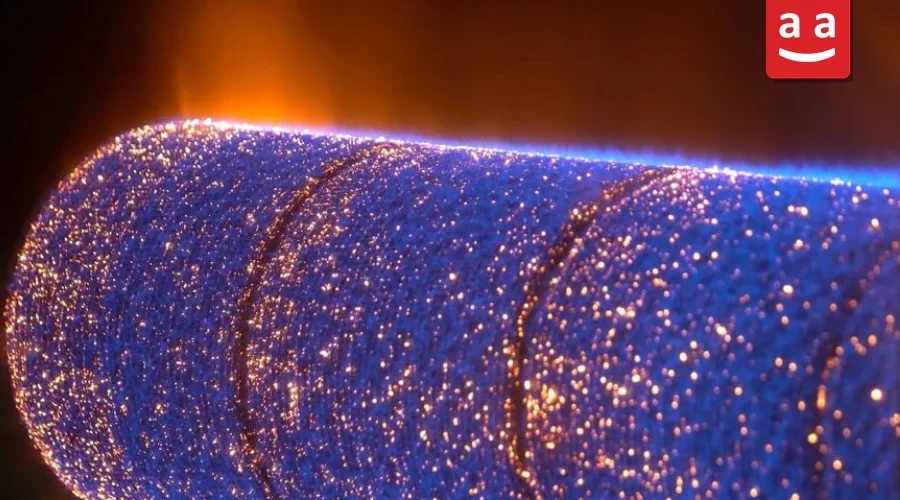
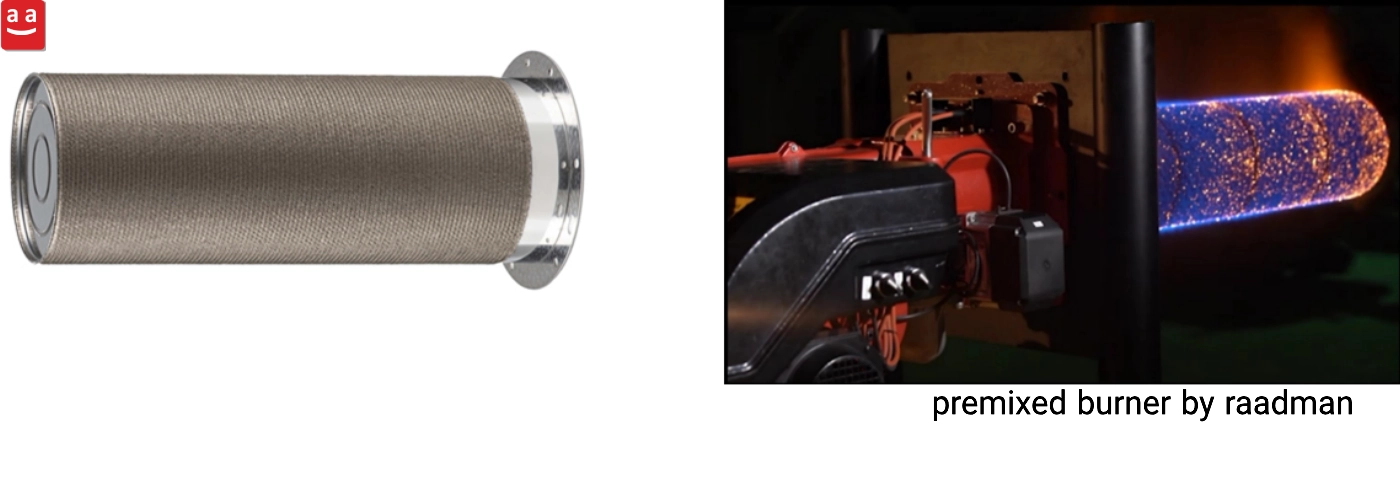
Metal fiber burners generally have a combustion head as illustrated below. This combustion head consists of a metallic cylinder with numerous very small holes along its side surface. Additionally, the side surface is covered with a woven layer of metallic fibers.
This unique structure facilitates the distribution of the fuel/air mixture along the combustion head and allows for a nearly uniform exit from the holes in the tube. Furthermore, the metallic woven layer enhances heat distribution throughout the burner head and increases radiant heat transfer from the flame to the boiler. This process lowers the flame temperature, thereby significantly reducing NOx emissions.
One of the limitations of these burners is that the inlet air must be largely free of dust, as dust particles can clog the combustion head holes and impair the burner operation. Therefore, the inlet air must pass through a filter to remove dust particles before it enters the burner. Additionally, liquid fuel cannot be used in these burners.
1- Raadman Premixed Burners (PE Series)
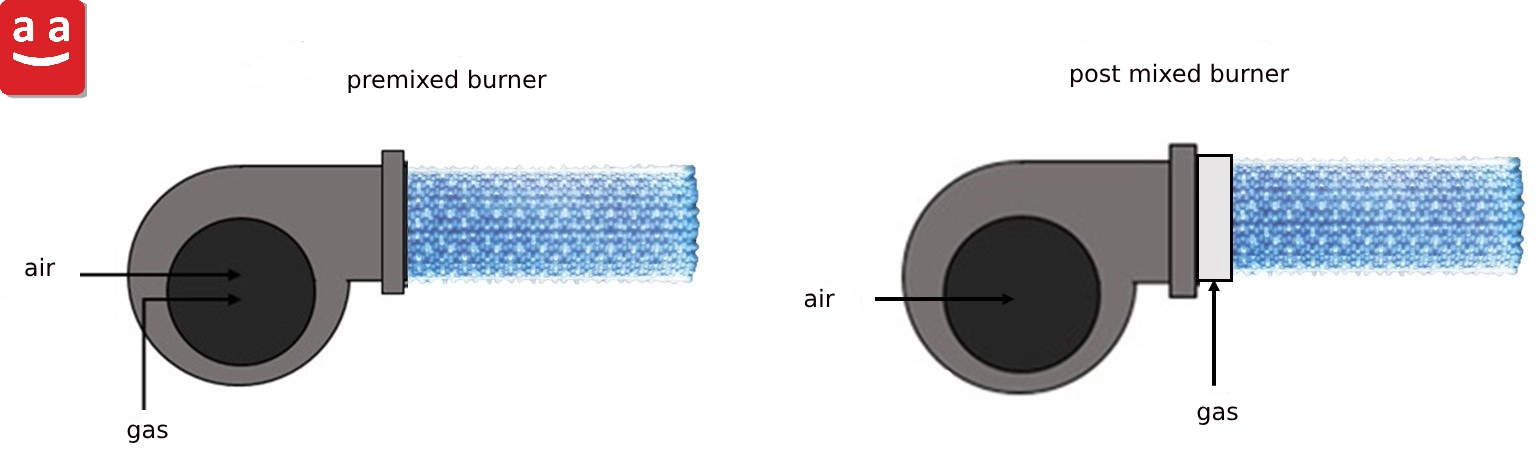
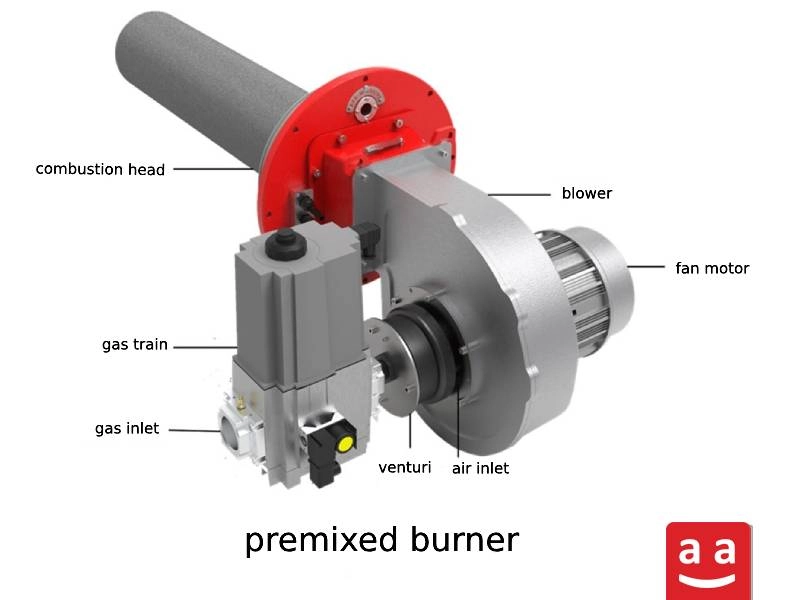
In premixed burners by raadman, the fuel is injected into a venturi put at the inlet of the fan. The venturi helps in drawing the fuel into the airflow. As a result, both fuel and air enter the fan together and are well mixed as they pass through the fan blades. In these burners, flashback can be even more harmful because it can damage the fan and electric motor. Additionally, the flame may escape from the combustion chamber, posing potential safety hazards.
To prevent unwanted ignition of the air and fuel mixture, the fans in these burners are made of spark-proof components and use brushless motors. The figure below shows a Raadman premixed burner and its main components.
To explore the different models available, visit the Raadman PE Series Premixed Burners page.
2- Raadman Post mixed Burner (PM Series)
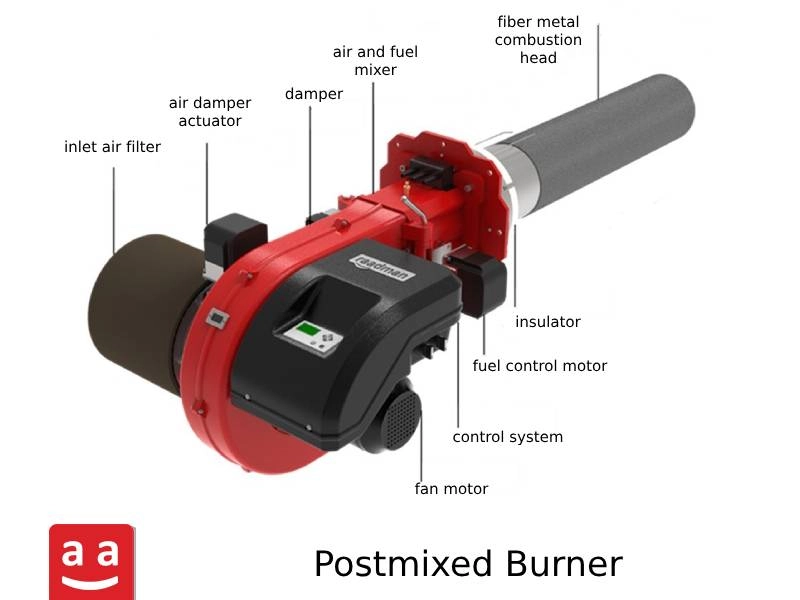
The post mixed burner is another variant of raadman’s premixed burners, primarily distinguished by its location and mechanism of mixing air and fuel. In post mixed burners, the outlet air from the fan first passes through a fuel and air mixer, and then the fuel-air mixture enters the combustion head.
In the mixer, gaseous fuel is injected into the airflow, allowing the fuel and air to mix together. This process ensures that the mixing of fuel and air occurs after the fan, thereby eliminating the risk of ignition within the fan, which means that usual fans can be used. However, this provides less time for the fuel and air to mix completely and uniformly, making the design of the mixer particularly important.
An improperly designed fuel and air mixer leads to poor mixing quality, which can result in localized combustion in excessively lean or rich conditions in certain areas. This creates high- and low-temperature zones on the combustion surface. In these zones, pollutants such as NOx and CO may be produced, and flame flashback could occur, introducing various risks. Consequently, poor mixer operation can decrease the benefits of using premixed combustion and metal fiber burners. The mixers in raadman’s PM series burners are specifically designed to blend fuel and air optimally, ensuring stable flame operation with very low emission levels.
To address these challenges, the mixers in Raadman’s PM Series burners are designed to ensure thorough and uniform mixing of fuel and air, resulting in a stable flame with very low emissions. For more information and to explore the available models, visit Raadman’s PM Series Post-Mix Burners page.
Supplementary Components of raadman Premixed and Post mixed Burners
In previous sections, the main components of raadman premixed and post-mixed burners were introduced, which include:
- combustion head made by fiber metal
- Fan
- Electromotor
- Air/fuel mixer in post mixed burners
- Gas injection venturi in premixed burners
However, these burners also have other components, which are briefly explained in this section:
- Gas Train: A specialized type of multiblock gas train is used in premixed burners, equipped with a zero-governor regulator. In these systems, a shutter is used to regulate the maximum gas flow based on the burner’s maximum capacity, while additional adjusting screw, known as the Offset, is used to set the minimum capacity. The gas train in post mixed burners is similar to those used in nozzle mix burners.
- Flame Detector: Both premixed and post mixed burners use an ionization rod to ensure the flame is properly formed.
- Air Filter: In post mixed burners, an air filter is installed at the air inlet to prevent dust particles from entering. However, in premixed burners, there is no air filter at the fan inlet, so the air must be filtered at the burner’s installation location.
Applications of Premixed Burners
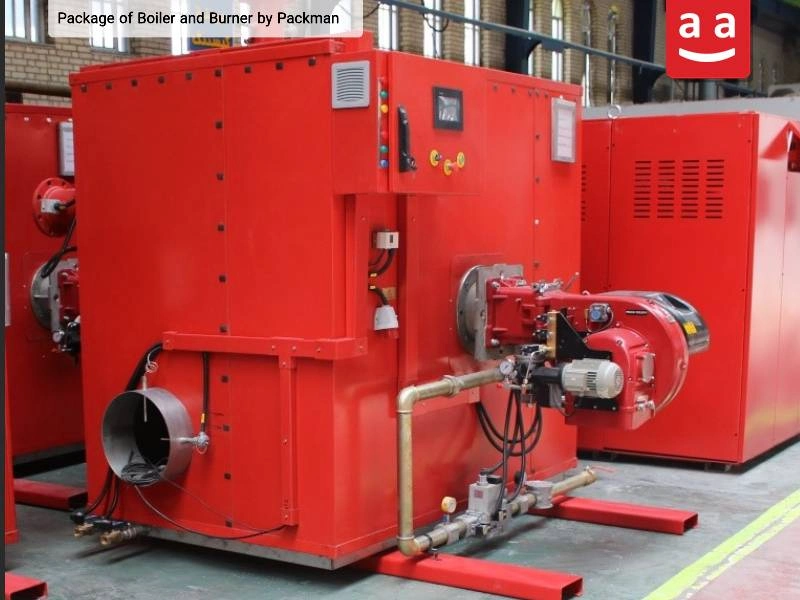
Today, premixed combustion is widely used in various applications including gas turbines, internal combustion engines, and premixed burners. The most important application of metal fiber burners, such as raadman’s premixed and post-mixed burners, which are produced in capacities ranging from 500 to 4000 kW—is in condensing boilers. These boilers have relatively small combustion chambers, making it impossible to use nozzle mix burners with large flames.
Instead, premixed fiber metal burners with confined flames within the combustion head are used. Furthermore, condensing boilers employ the maximum energy released during the combustion process. So, using these boilers together with premixed or post mixed burners can be an ideal package which offers an efficient and clean combustion in heating systems.
Comparison of Premixed, Post mixed, and Nozzle mix Burners
The table below provides the specifications of premixed, post mixed, and nozzle mix burners, allowing for a clear comparison between these types of burners.
| Premixed Burner | Post mixed Burner | Nozzle mix Burner |
| Air and fuel are mixed before reaching fan. | Air and fuel are mixed after reaching fan. | Air and fuel are mixed in the combustion head. |
| Fan motor is brushless type. | – | – |
| Gas train needs zero governor. | – | – |
| Carbon monoxide emission is nearly zero. | Carbon monoxide emission is nearly zero. | carbon monoxide emission is up to maximum 93 ppm, in accordance with the standard level |
| NOx emission, in class 4 | NOx emission, in class 4 | NOx emission, in class 1 & 3 |
| Lower noise production due to smaller flames. | Lower noise production due to smaller flames. | Higher noise production due to bigger flames. |
| Needs low-pressure gas train | Depending on the burner capacity, it has either a high-pressure or low-pressure gas train. | Depending on the burner capacity, it has either a high-pressure or low-pressure gas train. |
| The required excess air is up to 40 %, in accordance with the standard. | The required excess air is up to 40 %, in accordance with the standard. | The required excess air is up to 20 %, in accordance with the standard. |
Limitations of Metal Fiber Burners
Despite the many advantages of metal fiber burners, they do have some notable limitations, including:
- The potential for flame flashback, which must be carefully considered during the burner design process and when selecting its components.
- Sensitivity to airborne dust, requiring the installation of filters at the air intake. Gas and air filters must also be regularly maintained and inspected.
- Capacity constraints: Metal fiber burners are typically suited for medium-capacity applications and are not suitable for large boilers or high-capacity operations such as power plants.
- Fuel limitations: These burners are not compatible with liquid fuels and can only operate with gaseous fuels like natural gas or LPG.
Premixed Burners: Advanced Solutions for Emissions Reduction and Higher Efficiency
Premixed burners, including premix and post-mix types, are among the advanced solutions for optimizing combustion and reducing emissions. By ensuring precise fuel–air mixing before combustion, these burners can improve efficiency and significantly reduce pollutants such as NOx and CO. Metal fiber burners used in condensing boilers, particularly in capacities ranging from 500 to 4,000 kW, are a successful example of this technology, offering improved efficiency and lower emissions.
To learn more about nitrogen oxides (NOx) and how they form during combustion, read our article on NOx Reduction.
Despite their many benefits, premixed burners have certain limitations, including sensitivity to dust, the risk of flashback, and restrictions on the use of liquid fuels. These factors should be considered when designing and selecting a burner. However, optimized design and the selection of appropriate components can help mitigate these challenges and improve burner performance.
With advanced technology and precision engineering, Raadman premixed burners provide effective solutions for various industries, helping improve energy efficiency, reduce emissions, and optimize combustion processes.
Frequently Asked Questions About Premixed Burners
1- What are the benefits of using a premixed burner?
Premixed burners offer several benefits, including reduced emissions, improved energy efficiency, lower flame temperatures, and reduced fuel consumption. These features make them suitable for a wide range of industrial and heating applications.
2- What is the difference between premix and post-mix burners?
In premix burners, fuel and air are mixed before entering the combustion chamber. In post-mix burners, fuel and air are mixed downstream of the fan, in the mixer. These differences in the mixing process give each burner type distinct characteristics and applications.
3- Why are premixed burners used in condensing boilers?
Premixed burners are commonly used in condensing boilers because these boilers have compact combustion chambers that are not suitable for conventional nozzle-mix burners with larger flames. Premixed burners produce compact, confined flames that are well suited to these applications and help improve overall efficiency.
4- What is flame flashback, and why is it a major challenge for premixed burners?
Flashback occurs when the flame propagation speed exceeds the velocity of the incoming fuel–air mixture, causing the flame to travel backward into burner components, such as the mixer or fan. Because an ignitable mixture is present along the premixing path, flashback poses a significant safety risk and can damage equipment.
5- How do premixed burners reduce emissions?
By ensuring precise fuel–air mixing and controlling flame temperatures, premixed burners can reduce the formation of pollutants such as nitrogen oxides (NOx) and carbon monoxide (CO). Metal fiber burner designs can further support low-emission combustion when properly designed and operated.