

Heating is one of the fundamental needs in all buildings. In many cold regions, central heating systems are of great importance for providing the necessary warmth to ensure the comfort and well-being of individuals. Hot water boilers, as the heart of these systems, play a crucial role in supplying heat. Without the use of suitable boilers, heating buildings may become extremely expensive and ineffective. This is particularly important in residential environment, where maintaining a stable and controllable temperature for space heating and providing hot water is necessary.
For a detailed overview of industrial boilers, their types, components, and functions, you can read our Industrial Boiler article.
What is a Hot Water Boiler?
A hot water boiler is a device that produces hot water by using the thermal energy generated from fuel combustion, most commonly natural gas. The hot water produced is used in heating systems and supplying hot water in buildings, as well as in heat exchangers in industrial settings. These boilers, which are typically of fire-tube type, use the thermal energy released from fuel (like natural gas or oil) combustion to heat water. The hot water is distributed via tubes to different parts of the building, including radiators, fan coils, or other systems. The hot water boiler, due to its simple operation and high efficiency, is considered one of the most popular heating systems worldwide.
Types of Hot Water Boilers
Hot water boilers can be categorized based on condensation into two types: condensing and non-condensing. Additionally, based on their structure, they can be divided into three types: fire-tube, water-tube, and a combination of fire-tube and water-tube.
The table below presents a concise classification of hot water boilers based on their condensation type and structural design, along with their key characteristics and typical applications.
| Boiler Type | Structure | Key Feature |
Typical Application |
|
Fire-Tube Boiler |
Hot gases flow inside tubes | Simple design, easy maintenance | Residential and commercial buildings |
|
Water-Tube Boiler |
Water flows inside tubes | Higher pressure and capacity | Industrial facilities and large buildings |
|
Fire-Tube / Water-Tube Boiler |
Combined structure | Staged heat transfer |
District heating systems |
| Condensing Boiler | Heat recovery design | Very high efficiency, low fuel consumption |
Modern low-temperature heating systems |
| Non-Condensing Boiler | Conventional design | Simple construction |
Traditional heating installations |
Condensing Boilers
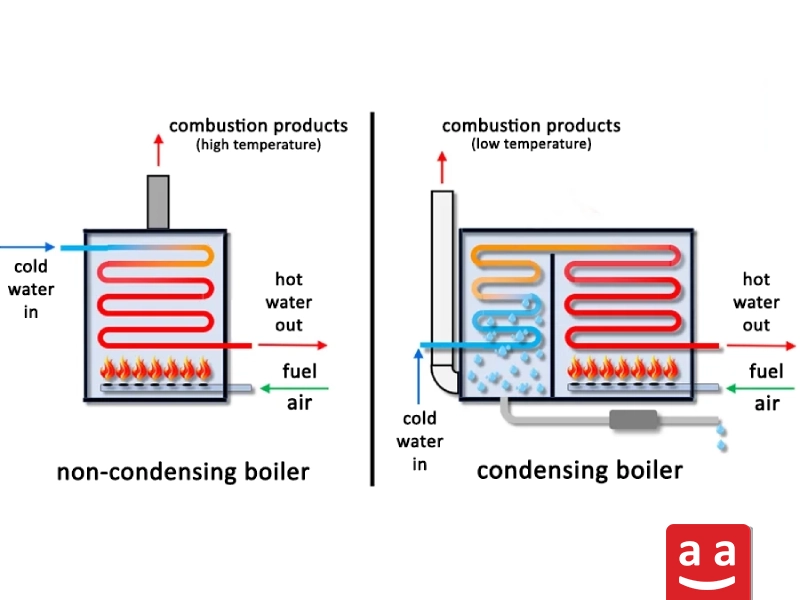
They are an advanced type of hot water boilers designed to improve boiler efficiency. These boilers achieve high efficiency due to the use of heat recovery technology from the hot gases produced by combustion. In non-condensing boilers, the water vapor from combustion exits through the chimney in the vapor phase. In contrast, in condensing boilers, the water vapor from combustion is condensed, and its latent heat is transferred to the inlet water. The burner used in these boilers can be either nozzle-mix burner or premixed burner type.
To learn more about condensing boilers, you can visit the article “what is Condensing Boilers”
Fire-tube Hot Water Boiler
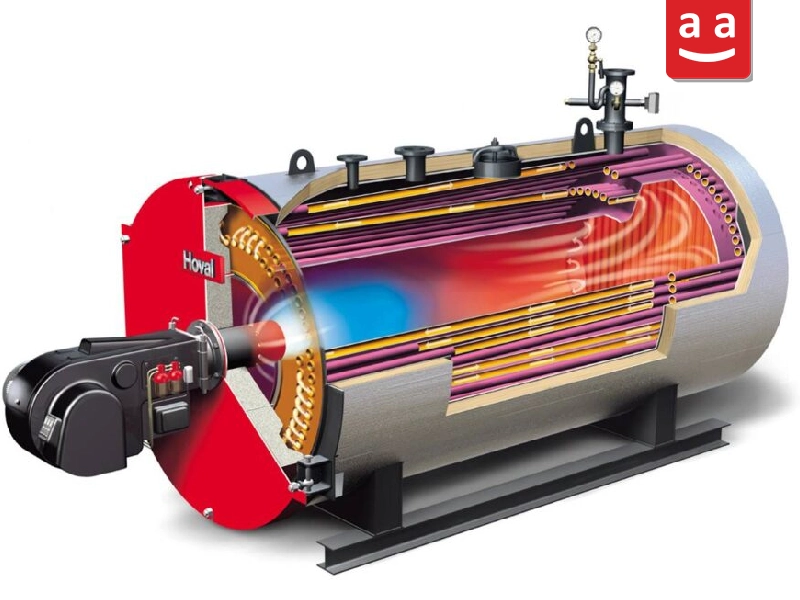
These are another type of hot water boilers. In fire-tube hot water boilers, water is contained within the boiler shell, while the hot combustion gases flow through the smoke tubes. When the burner is activated, the combustion gases first pass through the furnace. Then, they enter the reversal chamber and flow into the smoke tubes. Water enters the shell from the top, where heat exchange takes place. After the water reaches the required temperature, either hot water or high-temperature water (depending on the boiler’s operation) exits via the outlet. Combustion products are expelled through the chimney. The burner used in this boiler is of nozzle mix type.
for more information about fire tube boilers, visit this article: Comprehensive Review of fire tube boilers
Water-tube Hot Water Boiler
They are a type of water-tube boilers which produce hot water or high-temperature water. In water-tube hot water boilers, water flows inside the water tubes, while hot gases pass around the tubes. These boilers, like fire-tube boilers, can be either condensing or non-condensing. Depending on their inlet and outlet temperatures, they have varying heat exchange surfaces and, consequently, different sizes. Generally, water-tube hot water boilers in lower capacities are designed as condensing hot water boilers.
Fire-Tube-Water-Tube Hot Water Boilers
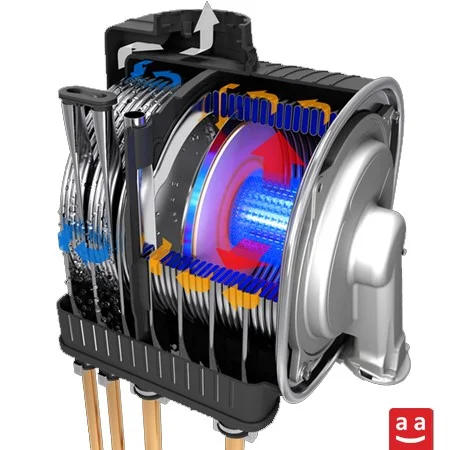
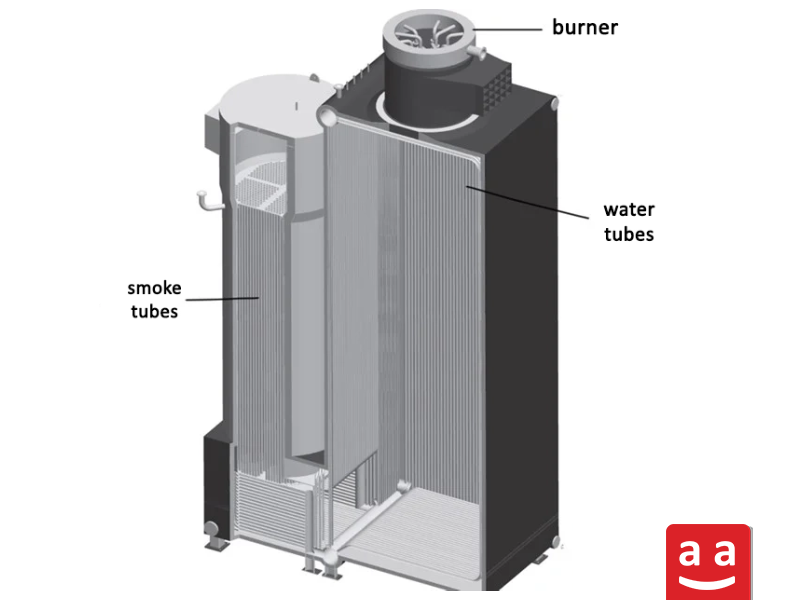
These boilers are a combination of fire-tube and water-tube boilers. Initially, the combustion gases enter the water-tube section of the boiler. Water flows through the water tubes and gets heated as it moves toward the end of the boiler. After that, the combustion gases enter the gas reversal chamber at the end of the boiler and then pass into the smoke tubes in the fire-tube section of the boiler. In the fire-tube section, water surrounds the smoke tubes and is heated. These boilers are primarily used for district water heating.
Main Components of a Hot Water Boiler
A hot water boiler consists of various components. Considering that hot water boilers are structurally divided into two categories—fire-tube and water-tube—aside from safety devices, pressure gauges, and thermometers, their structures may vary, and each is explained individually. Furthermore, components such as the water circulator pump, expansion tank, and water softener are examined, as they are crucial for the proper operation of the hot water boiler.
The table below summarizes the main components of a hot water boiler, outlining the function and role of each component in the overall operation of the system.
|
Component |
Function | Brief Description |
|
Burner |
Heat generation | Mixes fuel and air to produce a controlled flame for heating |
|
Combustion Chamber |
Combustion space | Enclosed area where fuel combustion occurs and heat is generated |
|
Heat Exchanger |
Heat transfer | Transfers thermal energy from combustion gases to water |
| Tubes (Fire / Water) | Energy transfer path |
Fire tubes carry hot flue gases, while water tubes allow water to flow inside |
| Circulation Pump | Water circulation |
Circulates hot water through the system and returns cooled water to the boiler |
| Expansion Tank | Pressure control |
Compensates for water volume expansion caused by temperature increase |
|
Control System |
Operation management | Controls burner, pumps, temperature, and safety functions |
|
Safety Valve |
Overpressure protection | Releases excess pressure to prevent system damage |
|
Pressure Gauge |
Pressure monitoring | Indicates internal boiler pressure |
| Temperature Gauge | Temperature monitoring |
Indicates water temperature inside the boiler or at the outlet |
| Chimney | Flue gas discharge |
Safely exhausts combustion products to the atmosphere |
| Resin Water Softener | Scale prevention |
Removes hardness ions to reduce scaling and improve heat transfer |
Components of a Hot Water Boiler; Fire-tube Boilers
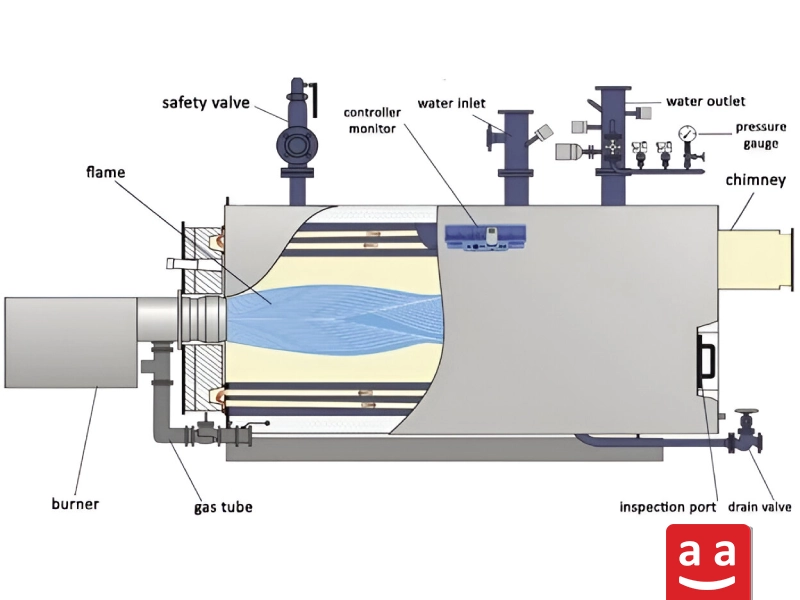
These boilers can operate as either condensing or non-condensing. All types share common components, including a furnace, a reversal chamber, a bundle of tubes, and a burner. Since combustion gases pass through the tubes, these tubes are commonly referred to as smoke tubes.
Components of a Hot Water Boiler; Water-tube Boiler
Similar to fire-tube boilers, these boilers can be categorized as either condensing or non-condensing. The main components of water-tube hot water boilers include water tubes in which water flows, the combustion chamber, the burner, and the chimney. If the water-tube boiler is condensing, a condensate chamber and a condensate water drain pipe are added to the main components.
To learn more about water tube boilers, you can read the article “Overview of water tube Boiler“.

Common Components in Hot Water Boilers
Hot water boilers consist of a set of components which work together to produce and distribute hot water. These components include burner, chimney, control system, safety valve, pressure and temperature gauges, circulation pump, expansion tank, and water softener, each playing a critical role in ensuring the boiler operates efficiently and safely. More details about each of these components will be explained below.
Common Components in Hot Water Boilers; Burner
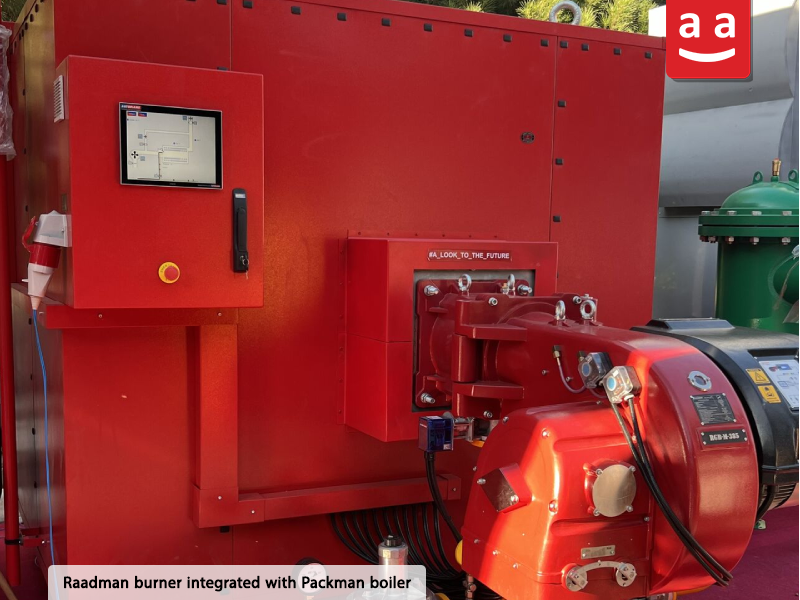
burner is one of the most critical components in a boiler, responsible for mixing fuel with air and generating a flame to produce heat. Burners differ based on the type of fuel used. For instance, gas burners are specifically designed to mix natural gas with air to create a stable flame. Precise control of fuel and air flow is crucial for improving efficiency and reducing pollutant emissions. Choosing the right burner in accordance with the boiler type and combustion chamber specifications is vital. For more information about industrial burners and their types, see the article Introduction to Industrial Burners
The burner design should be such that it prevents direct contact of the flame with the walls of the combustion chamber. If the flame size is not properly matched to the combustion chamber, damage to the boiler and its components is inevitable. Raadman burners, using advanced and up-to-date controllers, are capable of precisely adjusting the combustion process.
To ensure optimal performance of a condensing boiler and achieve maximum efficiency, it is crucial for the burner to function in a modulating way with a high turndown ratio. These characteristics allow for precise adjustment of the burner’s heat output, thereby reducing the exhaust gas temperature, which enhances the condensation rate and recovers energy from the water vapor in the exhaust.
Moreover, the modulating operation of the burner allows the boiler to adjust to varying thermal loads, ensuring it operates efficiently within its ideal performance range. This not only reduces fuel consumption and greenhouse gas emissions but also aids in extending equipment lifespan and reducing operational expenses. Raadman modulating and intelligent burners, utilizing the latest advanced controllers, can accurately regulate the combustion process to boost the efficiency and performance of condensing boilers.
Common Components in Hot Water Boilers: Chimney
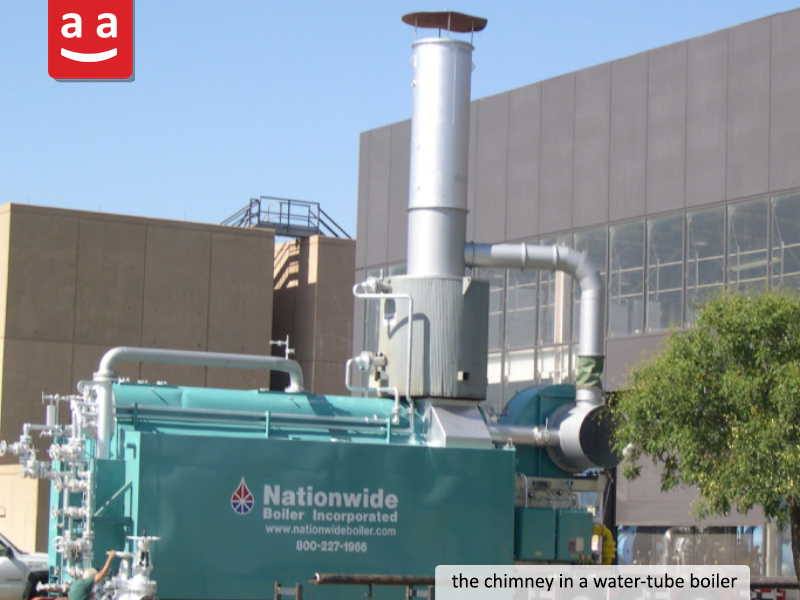
Another component of the boiler is the chimney. Combustion products, after transferring heat to the water in the boiler and cooling down, are expelled into the atmosphere via the chimney. The dimensions and height of the chimney play a significant role in creating adequate draft for proper exhaust.
Common Components in Hot Water Boilers: Boiler Control System
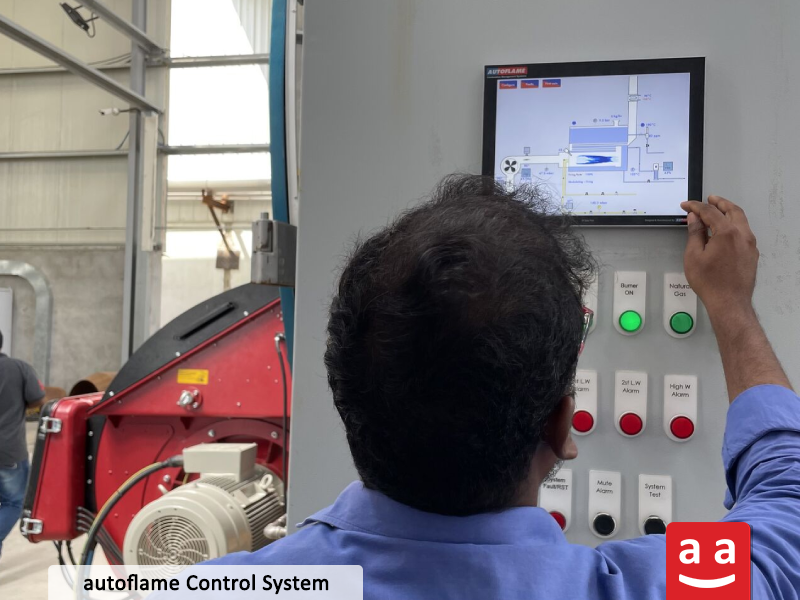
Control system is another essential component of a hot water boiler, designed to manage its operation according to predefined parameters. Advanced control systems can automatically turn the burner on or off, activate pumps, and even shut down the boiler in case of any dangers, such as excessive pressure or low water levels, to prevent damage to the equipment.
Common Components in Hot Water Boilers: Safety Valve
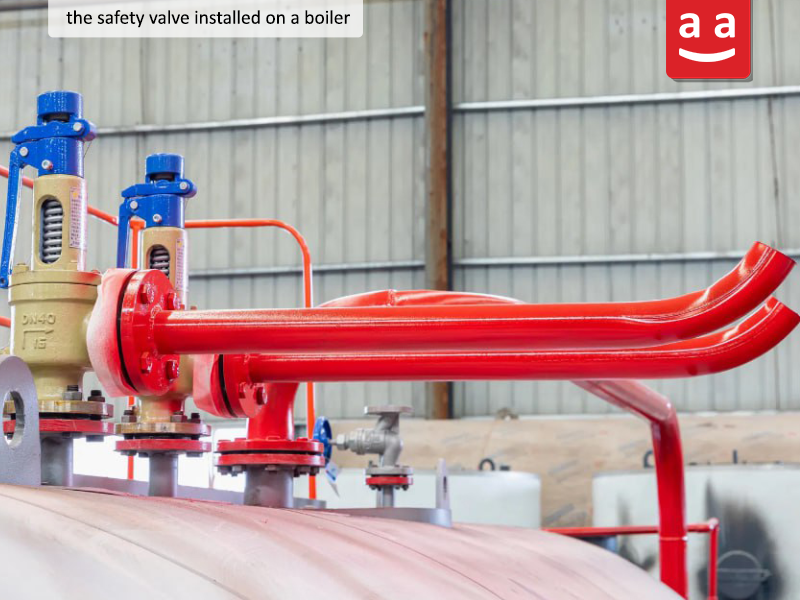
It is another part of a boiler. The safety valve is designed to release excess pressure from the boiler. If the pressure within the boiler becomes too high, it allows some water to be discharged, preventing damage to the system and avoiding explosion.
Common Components in Hot Water Boilers: Pressure Gauge or Manometer
Another component of the hot-water boiler is the pressure gauge, which displays the internal pressure of the hot water boiler. This allows the operator or automatic systems to monitor the boiler’s pressure and take corrective actions if it deviates from the recommended operating range.
Common Components in Hot Water Boilers: Temperature Gauge or Thermometer
The temperature gauge is another component of a hot water boiler that measures the internal water temperature and supplies the required data for ensuring the system operates efficiently. This device is typically installed at the outlet or inside the boiler.
Common Components in Hot Water Boilers: Circulator Pump
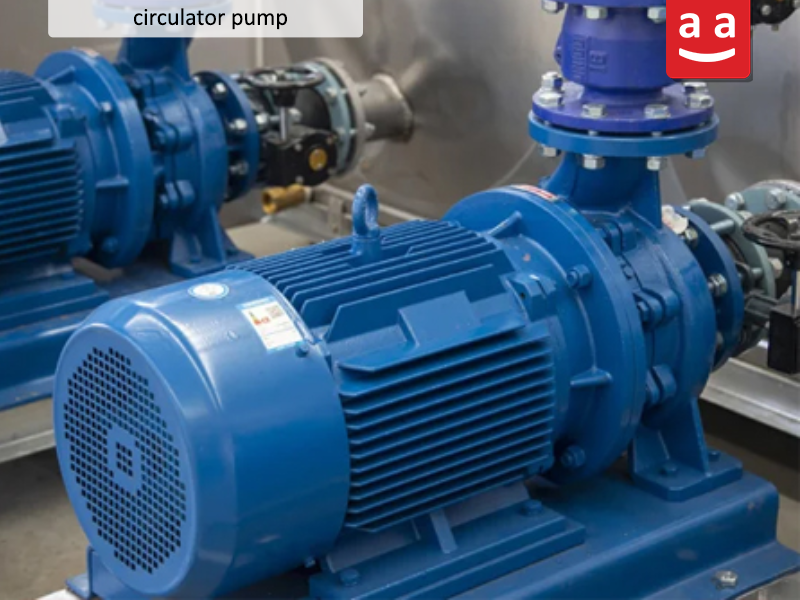
Another component of a hot water boiler is the circulator pump, which transfers hot water from the boiler to the heating distribution system or devices and returns cold water back to the boiler for reheating. Circulator pumps are of high importance as maintaining a continuous flow of water is essential for the appropriate operation of the system.
Common Components in Hot Water Boilers: Expansion Tank
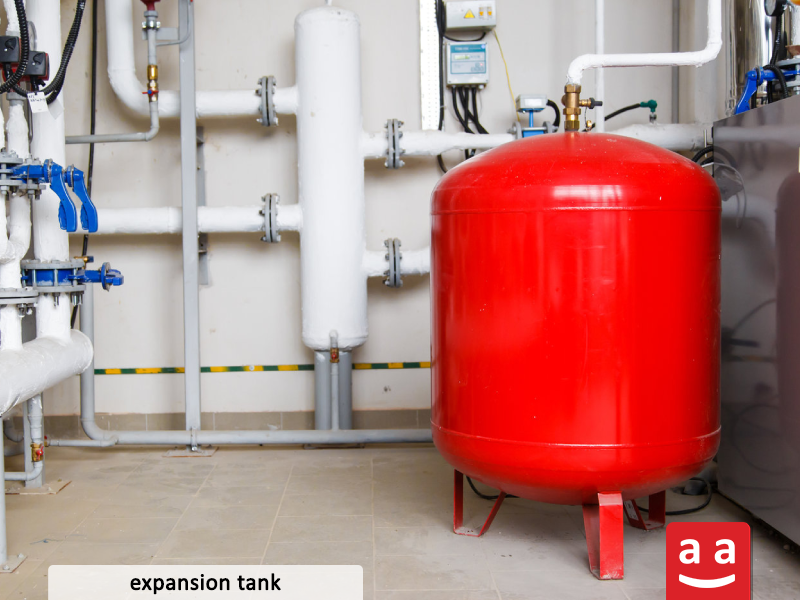
A hot water boiler includes a part known as the expansion tank. In a closed system, when the water heats up, its volume increases. If there is insufficient space for this expansion, the pressure in the system increases significantly, which could damage the boiler, pipes, and connected equipment. The expansion tank provides the necessary space for the water to expand, preventing excessive pressure buildup in the system.
Common Components in Hot Water Boilers: Resin Water Softener
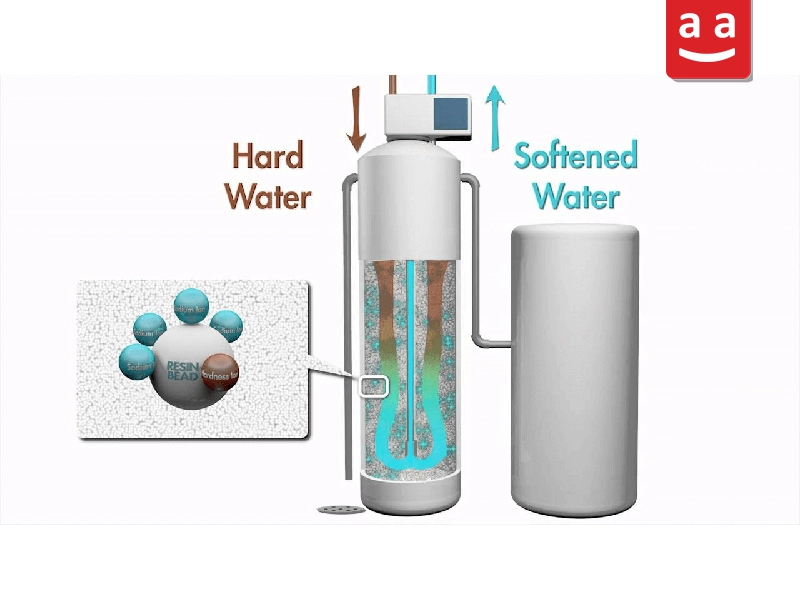
A resin water softener is a filter designed to remove calcium and magnesium ions from water. These ions are the main cause for water hardness and scaling. The scale acts as an insulator and reduces the heat exchange rate. This filter replaces calcium and magnesium ions with sodium and potassium ions, this filter replaces calcium and magnesium ions with sodium and potassium ions, turning hard water into soft water. resin water softener is a common method for removing water hardness, and it is also used in hot water boilers.
The Operation of a Hot Water Boiler
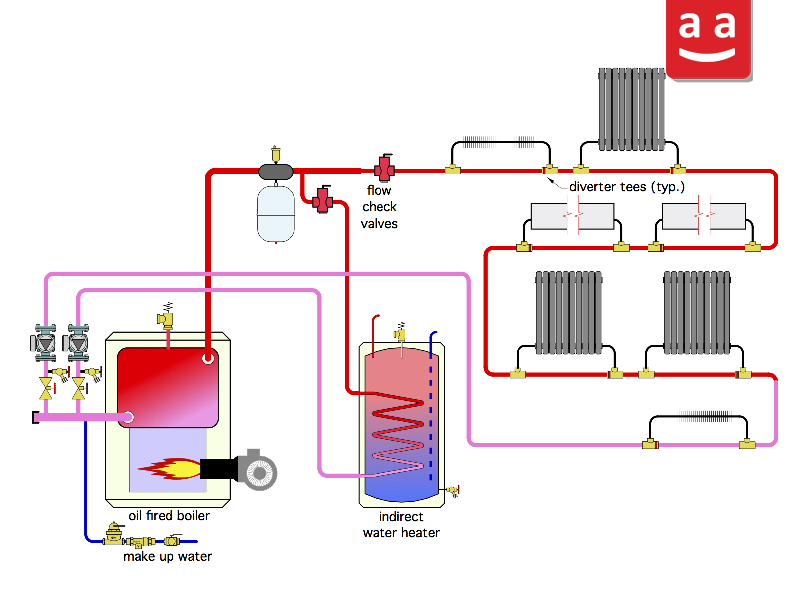
In a hot water boiler, the burner generates the necessary energy through the fuel combustion, which is transferred to the water inside the boiler. The heated water is pumped into the heating system or other systems. It travels through radiators or other heating units to various spaces, releasing its heat, and then returns to the boiler to be reheated, continuing the cycle.
Applications of Hot Water Boiler
Hot water boilers are widely used for providing heating and hot water in industries and buildings. Some of the key applications include:
Central Heating of Buildings
Hot water boilers are commonly used for space heating in residential, commercial, and office buildings through radiator and fan coil systems.
Domestic Hot Water Heating
Boilers are responsible for supplying domestic hot water, which is used for showers, washing, and other household purposes.
Process Water Heating in Industry
In certain industries that need water at medium or high temperatures, hot water boilers are used to heat process water.
Pools and Recreation Centers
Using hot water boilers for swimming pools is considered as one of the most effective methods of pool heating and is an ideal option for heating both residential and commercial pools.
Greenhouses
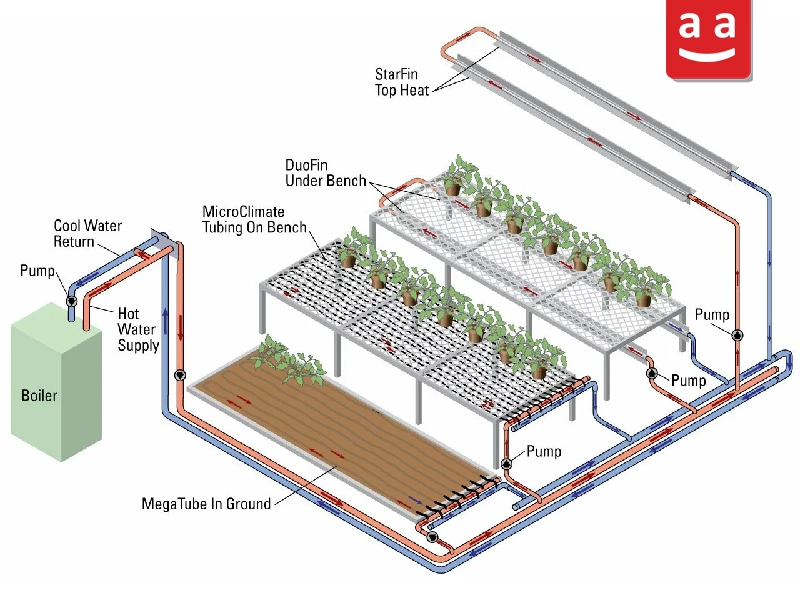
It is crucial to use a suitable heating system to ensure a consistent temperature inside the greenhouse. Hot water boilers are used to supply hot water for greenhouse heating systems, such as underfloor heating or piping along the walls.
You can read the article on greenhouse heating systems to get more information about greenhouses and the different types of heating systems used in them.
Hot water Boilers: The Key to Human Comfort
hot-water boiler, as one of the key components of industrial and residential heating systems, plays an important role in providing heat and optimizing energy consumption. Selecting the right boiler based on the specific needs of the environment is not only economically beneficial but also helps reduce energy consumption and enhance efficiency. With technological advancements in this field, newer hot water boilers with higher efficiency and lower pollution are a suitable option for a more sustainable and greener future.
Packman Industrial Group, recognized for manufacturing advanced boilers and offering high-quality services, is one of the leading suppliers in the field of hot water boilers. Given the advancements in technology and the variety of boilers available in Packman Industrial Group, users can choose the best option tailored to their needs.
FAQs About Hot Water Boilers
1. What is a hot water boiler and how does it work?
A hot water boiler is a heating device that uses fuel (like natural gas or oil) to heat water. The heated water is then circulated through pipes to radiators, fan coils, or underfloor systems to provide warmth. Once the water cools down, it returns to the boiler to be reheated, creating a continuous heating cycle.
2. What are the main components of a hot water boiler system?
A typical hot water boiler includes a burner, heat exchanger, circulator pump, expansion tank, safety valve, pressure and temperature gauges, chimney, and control system. Each part plays a role in safely producing and distributing hot water for heating or domestic use.
3. Which type of hot-water boiler is best for my building?
It depends on your heating needs and system design.
- Fire-tube boilers are ideal for small to medium buildings with steady heating loads.
- Water-tube boilers suit larger buildings or industrial facilities with higher pressure and temperature demands.
- Condensing boilers are the most efficient option for modern systems that run at lower return water temperatures